
Catch the Full Episode:
Overview
 HubSpot spent over a decade teaching small businesses how to build inbound marketing funnels. Then AI-driven search cost the company 140 million visits in under a year, an 80% drop in traffic. Revenue kept climbing anyway.
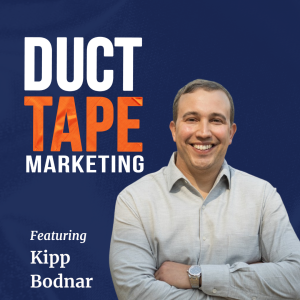
John Jantsch talks with Kipp Bodnar about what replaced that lost traffic. They cover building a “taste profile” so AI tools produce work that sounds like you, the upside and risk of simulating customer reactions before spending a dollar, and why answer engine optimization means writing for machines that now read like humans.
This episode is for marketers, agency owners, and solopreneurs who’ve watched their own traffic slide and want a concrete next step versus another AI framework to file away.
Guest Bio
Kipp Bodnar is CMO at HubSpot, where he’s worked for over 15 years, joining when the company had under $10 million in revenue. He co-hosts the podcast Marketing Against the Grain and sits on the boards of Gusto and Similarweb. His new book, co-written with Kieran Flanagan, is Loop: Outlearn. Outmarket. Outgrow., releasing September 22, 2026.
Key Takeaways
- Build a taste profile (a few hours clarifying what you believe about your customers and your brand) before using AI for content. If writing it out is hard, have someone interview you and feed the recording to AI instead.
- AI buyer simulations get more predictable, but the trade-off is average results. Save your riskiest ideas for real-world tests instead of running everything through a simulation first.
- The 3 most-cited sources on tools like ChatGPT and Claude are currently YouTube, LinkedIn, and Reddit. If you’re not active there, you’re less likely to get mentioned.
- If you don’t publish your pricing, AI answer engines will guess it, and often get it wrong. Being transparent earlier in the buyer journey works in your favor.
- What separates strong content from AI sameness is what’s unique to you: your own data, your customers’ stories, your specific history.
Great Moments
- [01:36] – Bodnar explains HubSpot’s 140-million-visit traffic drop and the decision to diversify beyond the blog.
- [03:45] – The 4 steps of the Loop framework: express, personalize, amplify, evolve.
- [08:56] – The risk of over-relying on AI buyer simulations for predictable results.
- [12:37] – Answer engine optimization and the shift to writing for machines that now read like humans.
- [18:05] – The big question: is inbound marketing dead.
Memorable Quotes
- “My taste profile version is always way better. I’m normally a C with generic AI, and an A with a taste profile.” — Kipp Bodnar
- “When you’re trying to simulate customer reactions so your results are really predictable, the risk is you end up doing what everybody else is doing. You get a highly predictable result, but the magnitude is low or average.” — Kipp Bodnar
- “We spent the last 20 years writing for machines that were trying to parse information like humans. Now we have machines that act exactly like humans, so you need to write exactly like you’re writing to a human.” — Kipp Bodnar
- “Inbound marketing as we know it is dead because it was predicated on a world where information was scarce. Now knowledge is abundant, and actions and attention are the scarce things.” — Kipp Bodnar
- “When we saw our traffic drop that fast, it was like, there has to be a better way. If this is happening to us, I’m sure it’s happening to others, and we need to get ahead of it.” — Kipp Bodnar
Resources
- Loop Marketing – HubSpot’s playbook for growth in the AI era
- Marketing Against the Grain – podcast
- Loop: Outlearn. Outmarket. Outgrow. – Amazon
- Loop – HubSpot preorder page
- Kipp Bodnar – HubSpot management bio
John Jantsch (00:01.24)
So, what if the same people that taught millions of businesses to build marketing funnels to generate inbound leads admitted maybe some of that's dead because they're the ones that killed it? Their own traffic dropped 80% almost overnight, but revenue kept climbing anyway. Hello, and welcome to another episode of the Duct Tape Marketing Podcast. This is John Jantsch. My guest today is Kipp Bodnar. He's the CMO at HubSpot.
Where he spent over 15 years since company had a little less than 10 million in revenue at that time. He also co-hosts the podcast Marketing Against the Green and serves on the board of Gusto and Similar Web. We're gonna talk about his new book, co-written with Kieran Flanagan, as called Loop. Outlearn, outmarket, and outgrow. So Kip, welcome to the show.
Kipp Bodnar (00:50.602)
John, thanks so much for having me. Pleasure to be here.
John Jantsch (00:52.332)
So so so when I read your co-author's name, I just immediately go into this Irish accent, which is terrible. But I'm I'm sh well, I'm afraid that people get very tired of that, but it's just it's such an Irish name. So I I mentioned the idea of HubSpot's traffic numbers going down. was there a like a time period? I mean, HubSpot's not loaned.
Kipp Bodnar (00:58.334)
I love it. Please. He he has a great Irish accent accent. Do the whole show in it if you want.
Kipp Bodnar (01:06.932)
completely.
John Jantsch (01:21.932)
A lot you guys had just done such a good Yeah, I was gonna say, you guys had just done such a good job of building a lot of organic traffic. was there like a day when somebody said, This is a problem. I mean we we actually we need to do something about this?
Kipp Bodnar (01:22.88)
Tons tons of people have.
Kipp Bodnar (01:36.821)
There's a couple things. One before this all happened, we knew it was going to be a risk for the future. So we bought a company called The Hustle. We we diversified well well beyond the blog, but we lost 140 million visits over the course of a year. And so what happened was between the rise of AI and Google doing a bunch of algorithm updates, you saw a pretty dramatic. Like at the start of that, it wasn't like you lose a little bit of visits and then it got
John Jantsch (02:04.216)
Yeah.
Kipp Bodnar (02:06.88)
gradually worse. It's like it dropped off pretty good, pretty quickly. And it's like, gosh, there has to be a better way. And if this is happening to us, I'm sure it's happening to others and will like or will likely happen to others. And we need to get ahead of all of this.
John Jantsch (02:19.234)
Yeah, yeah.
John Jantsch (02:23.138)
Just from my own experience, our traffic is probably down 50% from its, you know, from its high. But we pr pretty quickly realized it was a lot of garbage traffic. you know, it yeah. Yeah. I mean, and you guys did, you know, you had the listicles. I mean, you had all the stuff that that drove eyeballs that probably wasn't very high value traffic. So, you know, in some ways are we better off, you know, well, you know, not having to try to chase that.
Kipp Bodnar (02:32.116)
Lot of it was garbage traffic. It's a key insight for everyone.
Kipp Bodnar (02:39.37)
Yeah, of course. Yeah.
Kipp Bodnar (02:54.354)
look, I think we're better and worse off at the same time. I think I think the ability to bring people to a site that you owned and you controlled and you could really shape their interactions versus being more reliant on podcasts and YouTube and TikTok and reels and everything else that's out there, you know, which you're limited to those platforms and their guardrails and their rules, that's probably the tough trade off.
John Jantsch (02:56.962)
Yeah, okay.
John Jantsch (03:03.79)
Right, right, right.
John Jantsch (03:12.374)
LinkedIn, even yeah.
Kipp Bodnar (03:21.834)
Are we better off for maybe not wasting as much time and effort on people who are never gonna buy our products? Also, probably a good thing. So I think like everything in life, there's good and bad.
John Jantsch (03:28.472)
Yeah.
Yeah, yeah, yeah. So one of the things you talk about in the book is the idea of the marketing funnel being dead. what's something that loop does that the funnel maybe structurally didn't or couldn't?
Kipp Bodnar (03:45.109)
Yeah, so if if I think about Loop, Loop is our framework for how you actually do marketing in this post AI world. And the reason for that, it you have to optimize for learning. AI, what it actually does is it enables you to scale your brains, your taste, all the things that make you and your company really good. And allows you to do a lot more, but you can also do a bunch of crap. And you can also fail to learn and compel in those lessons. So what Loop does is it gives you a playbook to
John Jantsch (04:01.762)
Yeah, yeah.
Kipp Bodnar (04:14.208)
Kind of do any marketing tactic or campaign that you want. And there's kind of four simple steps to it. First is you work with AI to express your ideas and your and get them into content that's really remarkable and personal to your audience because AI can bring all that context together, your customer interviews, what people are saying you about online, conversation your sales teams are having, and make that and turn all of that into really great content with you based on your insights and your perspective. Then
The other thing we found that AI is really good at is helping you tailor the second part of the framework to make that content deeply personal on an individual basis. Then AI has opened up new distribution channels, and that's the third step amplification. Those are things like answer engine optimization, working with influencers. AI has transformed advertising. It's made advertising far more scalable than I think it was in the pre-AI world. And the fourth step is evolve. The one thing that AI
John Jantsch (05:00.95)
Mm-hmm.
Kipp Bodnar (05:13.492)
has really does well that nobody's really taken on yet is it helps you codify your learnings and put them into systems that keep getting smarter every time you use them. And so that's what we set out to do. We wanted to answer the question, like every market I talk to is getting yelled at by their CEO. Well, why is our traffic down and how do we do AI in this AI world? Like what the heck do we do? And we wanted to, I wanted to write something that I could hand to anybody who asks me that question and give them a real concrete answer.
John Jantsch (05:43.117)
Yeah, in fact I I just started playing with it today. It may come out earlier in the week, but Claude just introduced a anthropic just introduced a skill builder that it basically just follows you around. It's like, you know, if you're gonna do a process, you're gonna go on Slack for this, you're gonna go here, you're gonna go here, and it and then it's like, okay, I'll build a skill that does that. so that that idea of codifying is just getting easier and easier and easier, isn't it?
Kipp Bodnar (05:53.92)
Mm-hmm.
Kipp Bodnar (06:09.539)
I i the thing it's a perfect example.
John Jantsch (06:11.414)
Yeah. So you talk about something called a taste profile. I wonder if you could walk me through the solo entrepreneur, you know, who doesn't have an entire marketing team, how do they build a taste profile?
Kipp Bodnar (06:15.243)
Yeah.
Kipp Bodnar (06:20.012)
Yeah.
Well, see, this is the fun part, is that the taste profile I think is most beneficial to like the small, small team or the solopreneur, right? Because all a taste profile is, is spending a few hours to make the decisions that you know, but haven't like had the exercise to clarify all of them, so that you can actually then give those decisions to AI and AI knows what you want to achieve and has all the context around what you want to achieve. And so it's essentially two parts. The first is
John Jantsch (06:31.362)
Yeah, yeah.
Kipp Bodnar (06:52.011)
Customer taste and might be a s we give you a list of questions to go have AI do research for you. Even so if you're a solopreneur, you use those questions, you go do the research, and you kind of understand what the market and the customer thinks your category and how your product might fit into there. The second part of this is like brand taste. So like what do you think about? Like, why does your company exist? What does your product solve in the world? You know.
What do you what do you believe about the world that's unique and differentiated? Like how do you think about your thought leadership? And we give you very specific questions to kind of go through and get to clarity on those. And then once you have all that together, you put that in any AI tool. I do it all the time. I'll do a blank version and then I'll do a taste profile version. And my taste profile version is always way better. I actually built like an independent grader to C. And I'm normally like a C with generic AI and like I'm an A with a taste profile. And it's one simple thing that
It takes you a couple hours to do once and then you probably need to update it, you know, a couple of times a year, depending on how your your business changes.
John Jantsch (07:53.154)
Yeah, I mean we run across that all the time. You know, that that we because we're the same way. We're like, look, you gotta put all this stuff together. It's a little work in the beginning, but it will save you so much time and and so much better output, right? In the end. and and people want to skip that. It's like, I don't want to sit down here and answer all these questions, but I'm yeah.
Kipp Bodnar (08:12.287)
It's hard. You have to make the hard choices. You know, like that's the like this is real marketing though. Marketing is the I I had David Epstein on the marketing Instagram podcast recently. And he's like, Look, the people who are succeeding in this new world are brain first, tool second versus tool first, brain second, right? And that's that's what this is all about.
John Jantsch (08:27.35)
Yeah, yeah. Yeah. Yeah. It's it's another vote for a good liberal arts degree, isn't it? So you talk about something in the book called the AI buyer sim. and you go as far as saying I think that it can predict customer reactions with ninety percent accuracy. first off, that's amazing. we ought to all be using that right, but
Kipp Bodnar (08:34.277)
Yeah, g exactly right.
Kipp Bodnar (08:52.575)
Yeah. Yeah, absolutely.
John Jantsch (08:56.77)
What is the I'm I'm gonna go go the opposite side of you of of that idea. What is the risk of kind of relying on that type of data and being wrong?
Kipp Bodnar (09:08.289)
I like this question. here's the risk. marketing, I I think of marketing as this interesting relationship. And it and I see everything in like frameworks and graphs and charts and two by twos. And the two by two here is like how predictable the results you'll get from it, and then how high or what's the magnitude of those results, right? And so when you're trying to simulate your results and predict your results so that they're really predictable, the risk of that.
John Jantsch (09:19.383)
Yep.
Kipp Bodnar (09:36.8)
Is that you're gonna do what everybody else is doing. And when you do what everybody else is doing, you're gonna get an average result. So you're gonna get something that's highly predictable, but the magnitude is gonna be kind of low or average. And so what you're leaving on the table is like the crazy thing that might fail a bunch of times, but when it hits, hits really big. And that's the biggest risk in taking taking that. And so you should use the taste profile for things that you know, or excuse me, you should use the BIOSIM for things you know, like kind of.
John Jantsch (09:46.926)
Mm-hmm.
Kipp Bodnar (10:03.861)
I know how this is gonna work. I I have this tried and true, but for new things I wanna go outside of that and really do some wild tests.
John Jantsch (10:12.685)
So one of the things that I think a lot of people are suffering from i is this, you know, even though organic traffic is way down, people are still producing, you know, stuff that AI sameness, I think you call it. A lot of people have called it that. so so what's the sort of what's the marker that says, no, this is actually above all of that? This is better quality, this is you know, this is done I mean, is it just the amount of time you spend, the amount of research, the amount of
Kipp Bodnar (10:25.58)
Yes.
Kipp Bodnar (10:35.671)
Yeah.
John Jantsch (10:41.429)
Citations, you know, I mean what is it that makes it get out of that sameness?
Kipp Bodnar (10:46.231)
So I think this is what's interesting. Pre AI, you could just be prolific. Right? You could just, hey, I'm gonna outgrind, I'm going to write some stuff. The stuff doesn't have to be great.
John Jantsch (10:50.859)
Yes. Right.
John Jantsch (10:55.795)
I remember I remember people I remember people asking me all the time when I'd talk about blogging, how many words does it have to be? You know, like like that was the yeah that was the marker.
Kipp Bodnar (11:04.233)
yeah, that was a that was a topic for years. Yeah. And and so, and now now it's not good enough to be prolific. Like I call this kind of like the Taylor Swift problem. Like you have to be prolific like she is, but you also have to be great. Like the things you have to do have to be great. And you're asking me the questions like what makes great content in a world where somebody can type something into a chat GPT, a Claude, and get any information they want. And what I what I found is that.
John Jantsch (11:17.761)
Yeah.
Kipp Bodnar (11:34.004)
It is the things that make your that are unique to you or your business. And so that is, do you have unique data? You I know you have unique customers, and those customers have unique stories. You yourself, if you're a solopreneur, have a unique history and framing and life story that you have to bring to the table. There is there is a level of like research and rigor and putting things together in clever ways that people wouldn't expect.
John Jantsch (11:39.521)
Yeah. Yeah it's
Kipp Bodnar (12:02.975)
I think those are some of the key highlights that make if you just go around and pay attention to what you think is good and interesting, you'll find that those are kind of the backbone of most of most of the things.
John Jantsch (12:14.377)
Yeah, I tell people all the time. It's like, what's the only thing what's the thing that only you could write about? Nobody else in the world could. You know, and they they they start thinking about that and they're like, okay, I could add that. Like you said, customer stories, you know, is is an easy one because everybody should everybody should have those. Yeah. So talk a little bit about you mentioned already, I think, answer engine optimization. how does that go beyond just writing FAQs?
Kipp Bodnar (12:18.761)
Yes. I love that.
Kipp Bodnar (12:28.927)
One hundred percent. Everybody has that.
Kipp Bodnar (12:37.718)
Yeah.
Kipp Bodnar (12:41.877)
Yeah, so answer engine optimization is a very interesting topic. It's something that everybody's obsessed with. Like, what does ChatGPT, G Google Gemini, Claude, Perplexity, what do all these things say about me and how do they talk about me? And the first thing you need to do is understand like how visible you are on those answer engines. So what's your visibility? And that comes in two terms: mentions and citations. Mentions are just like, do they talk about you and do they talk about you positively or negatively?
John Jantsch (12:47.553)
Right.
John Jantsch (12:50.869)
Yeah.
Kipp Bodnar (13:11.105)
Then citations are like, do they link back back to you? And something you you you have to say. And you're right that FAQ pages are one way to do that. The three most cited resources on Chat GPT and Claude, for example, though, and Gemini, for example, though, are YouTube, LinkedIn, and Reddit. So if you're not involved in YouTube, LinkedIn, or Reddit, you're probably less likely to get mentioned on the topics that are relevant to your business.
John Jantsch (13:13.877)
Mm-hmm.
John Jantsch (13:32.577)
Yeah, yeah.
Kipp Bodnar (13:39.489)
The other thing you have to do for content you do own, like your website, it's not just FAQs. The way I like to explain it is we spent the last 20 years writing for machines who were trying to parse information like humans. Right? It's like you had all this deep meta description, keyword density, all these things. Now we have machines who act like exactly like humans. And so you need to write exactly like you're writing to a human, but simple, plain spoken.
John Jantsch (13:58.348)
Right. Schema, yeah.
Kipp Bodnar (14:08.694)
non you know, non-jargon framed in easy chunked segments so that this machine who re who acts exactly like a human can pick those couple sentences up. Like if you go to our CRM page, right, there's a what is the CRM box and it's three sentences and it's very in plain English explaining to you what a CRM is.
John Jantsch (14:30.197)
I think in your particular case, like all SaaS offerings, you know, there's typically pricing, you know, has been on your pages forever. but but but for a lot of businesses, that's a new idea, or just even the fact that, you know, their whole goal was to get somebody on a phone call so that they could then explain how everything worked. How how do we have to now start thinking about the fact that that the buyer journey is going to go a lot farther?
Kipp Bodnar (14:36.47)
Yeah. for for sure.
John Jantsch (14:57.356)
you know, bef maybe before we get that phone call and that we need to reveal a lot of information that maybe we wanted to hide because we didn't want our competitors to have it.
Kipp Bodnar (15:08.088)
So the reality is the interesting things, good and bad, about LLMs is they will give you an answer. Right? It will always give you an answer. So if somebody asks what your price is, one, if it had if there's just no information on the internet about it, it will make something up. If there is information your customers are talking about it on Reddit or G2.com or some of these places, it'll aggregate that. And what I have found is it's often wrong.
John Jantsch (15:13.931)
You're right. Yeah. Yeah.
John Jantsch (15:25.337)
Yeah.
John Jantsch (15:29.877)
Right, right,
John Jantsch (15:35.533)
Yeah. Yes, yes, yeah.
Kipp Bodnar (15:36.225)
And it's often misanchors me. It's like, I think this thing's gonna be $50. And it turns out it's $500. And like, wow, I was that I I don't want that thing. I was expecting it was gonna cost a very different amount. So I look at this as like, you have to provide that information because if you don't, you're gonna have buyers who are gonna get an answer anyway, and it's not an answer you want them to get. And so you're gonna have to operate more transparently than I think that you want. And by the way.
I think that's a good thing. I think you're probably likely going to attract more people by doing that than by hiding it.
John Jantsch (16:06.636)
Yeah.
John Jantsch (16:12.373)
So one of the steps you mentioned was evolve. what does that look like day to day for a marketer?
Kipp Bodnar (16:15.286)
Yeah.
Kipp Bodnar (16:21.152)
Yeah, so the way I think about the evolution of marketing and what it means to evolve is like it used to be, let's say I had a I have a Google AdWords campaign on. I maybe I've run a Google AdWords campaign, I run a weekly email campaign. It used to be, well, all right, like once a month, maybe once every couple weeks, I'll look and see how that's going. Right? And I'll look and I'll make make a few little tweaks. Now it's like I can, you know, at HubSpot, we have our Breeze assistant, like our version of Claude inside HubSpot's like,
You can ask any of it any of these insights anytime you want and get instant learnings and change much faster, right? And be like, not only do I can I get this information, I can get recommendations from this thing that's really smart and knows my business, right? And then I can actually change way more rapidly. The other part of what Evolve means is you have some system. You run your business off systems. And in this AI world, there are
John Jantsch (16:59.393)
Yeah, yeah.
Kipp Bodnar (17:19.756)
You know, agents, there's skills, there's workflows. You can actually have AI update your systems based on what you learn. And that's the big unlock. Before AI, you couldn't do that. You would have to remember, I need to go make this change to my system based on this thing I learned. Exactly. It's in eight places. my cousin Tim actually set this up for me, so I gotta wait till he's back from vacation so that he can update it for me. Now you can just.
John Jantsch (17:28.095)
Mm. Yeah, yeah, yeah.
John Jantsch (17:35.341)
And it and by the way, it's in eight places.
Kipp Bodnar (17:47.523)
have it do it in the background and like run a recurring task. And that is transformative because we all know the power of compounding, right? Like you you do that, you add have an update a smart learning every week, you know, half a year in, you're like getting massively better results.
John Jantsch (18:01.46)
Yeah, yeah, yeah. Yeah, yeah. With with real data. All right, here's the here's the big question, you ready? Is is inbound marketing dead?
Kipp Bodnar (18:05.75)
With real data.
Kipp Bodnar (18:10.7)
I'm ready, please.
Kipp Bodnar (18:15.372)
I think inbound marketing as we know it is dead because it was predicated on a world where information was scarce. And and and and knowledge was scarce. Now knowledge is abundant and actions and attention are more scarce. And so I think the loop loop framework as well as all the work that everybody's doing in the marketing world today is trying to go beyond that old world and help companies thrive in in this new one.
John Jantsch (18:25.025)
Yeah, yeah.
John Jantsch (18:43.936)
Did did you have to actually be the one to tell Brian and Dormash that that that finding?
Kipp Bodnar (18:47.032)
We had a we had a nice debate. You know, so the the loop book that that everybody's gonna read on September twenty second started as like a ten page memo that I wrote. And the name of that memo was In Bell Marking is Dead. And it it wasn't even called Loop at the time, but it was all the these observations that you and I are talking about. But this was, you know, eighteen months ago, you know, a long time ago.
John Jantsch (18:58.18)
okay.
John Jantsch (19:02.56)
Mm-hmm.
John Jantsch (19:12.128)
Yeah, awesome. All right. So if a small business owner, this is always the hard question, actually. Small business owner reads reads the book. What's the one page they should act on this week? You don't have to cite a page number. As a as an author also, I I know when people ask me that, I'm like, I don't know. I wrote that 18 months ago. But what's the one concept? How's that that they should act on this week?
Kipp Bodnar (19:16.002)
Yeah. Yeah, let's do it.
Kipp Bodnar (19:26.206)
Mm-hmm. Yeah.
Kipp Bodnar (19:36.672)
Yeah, we talked about it earlier in the show. I think you should do fill out your taste profile. It's it's it's it's on it's i early on in the book, because that way your your AI tools have all the context of you, your business, and your taste, and they will just make far better decisions. Even if you don't know it, it will happen.
John Jantsch (19:58.112)
Do you one thing that we've we've found s like if I tell somebody you need to fill out your taste profile, they sit there and they go, I can't answer all these. But if I actually ask them the questions, interview them, th all of a sudden they'll talk for hours. so th that's that's a tip you might give people. Yeah. Yeah.
Kipp Bodnar (20:08.759)
Yes.
One hundred percent.
well first of all I love that and second of all if you're listening to this show and you're feeling that way, have a friend, have your spouse, have somebody just, you know, open the book, write down the questions separately and just record you. And then by the way, you can just upload that video to AI and you won't have to ever type or write anything and it will take care of it all for you.
John Jantsch (20:25.004)
Yes, exactly.
John Jantsch (20:33.024)
Plus it sort of automatically gets your voice and tone and how you speak and all that kind of stuff. I love. Yeah. Yeah. Awesome. Well, Kip, I appreciate you taking a moment to stop by the Duct Tape Marketing Podcast. Is there some place you'd invite people to connect with you, find out more about Loop and everything else you're up to?
Kipp Bodnar (20:35.724)
Yeah, exactly. That's a that's a great point.
Kipp Bodnar (20:49.0)
Yes. So you can obviously learn more about Hubswata Hubs dot com. You can find the book at loopmarketing dot com. And then for me, you can find me on Marketing Against the Grain, on YouTube and wherever you get your podcast.
John Jantsch (21:01.908)
Awesome. Well again, appreciate you stopping by. Hopefully we'll run into you one of these days out there on the road.
Kipp Bodnar (21:06.462)
Awesome. Thanks, John. Appreciate you having me.
Sign up to receive email updates
Enter your name and email address below and I'll send you periodic updates about the podcast.