

Catch The Full Episode
 Overview
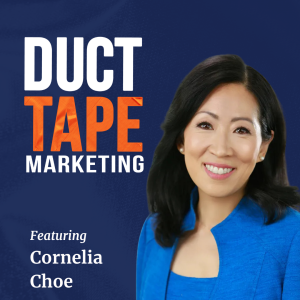
Most leaders believe they see the whole picture. The trouble is, we all have blind spots. In this episode of the Duct Tape Marketing Podcast, John Jantsch talks with international leadership expert Cornelia Choe, co-author with Marshall Goldsmith of The Panoramic Leader: How Great Leaders See Differently. Choe unpacks what she calls perspective blindness.
The conversation covers how AI has made data cheap but judgment scarce, why more than half of employees using AI never verify what it gives them, and the reasons senior teams often disagree on how ready their own companies are for change.
Choe introduces her GEM framework (Get up close, Establish meaningful bonds, Map your evolving perspective) to help leaders close these gaps before they cause damage. She also shares her personal history of moving from Minnesota to Seoul at age 10, and how that experience has shaped her thinking with regard to mental maps and blind spots.
This episode is for small business owners, agency leaders, and consultants managing teams through constant change. If you’ve ever assumed your customers, employees, or leadership team see the business the way you do, this conversation will challenge that assumption and give you a framework to address it.
Guest Bio
Choe is an international leadership expert, global keynote speaker, and Thinkers50 Radar honoree. She is the founder of The Leaders Alliance and has advised leaders at organizations including the United Nations and the White House. She is the co-author, with Marshall Goldsmith, of The Panoramic Leader: How Great Leaders See Differently. Choe grew up across eleven different places on three continents by age eighteen, an experience that informs her work on mental maps, cultural blind spots, and perspective in leadership.
Key Takeaways
- AI made information easy to access, but it has not made judgment easier. More than half of employees using AI do not verify what AI gives them, and have made mistakes because of it.
- Perspective blindness is the belief that you see the whole picture when you only see a piece of it. No single leader can track every change happening across a company or market at once.
- Choe’s GEM framework offers three steps: get up close to people who think differently, establish a trusted relationship with them over time, and map how your view of the situation changes as a result.
- Microtranslations matter. Two leaders can look at the same data and walk away with completely different conclusions if they never explain their reasoning to each other.
- Outside perspective is one of the fastest ways to spot a blind spot, since an outsider will question “this is how we’ve always done it” in ways insiders rarely do.
Great Moments
- [00:02] – John opens with the question driving the episode: what if the thing limiting growth is not what you’re doing, but what you can’t see.
- [01:41] – Choe explains how AI has commoditized data and why that is dulling judgment, backed by survey data on employee mistakes and unverified AI use.
- [03:53] – Choe defines perspective blindness and explains why no leader can track every change happening around them.
- [05:00] – John and Choe discuss why there is no lasting “new normal,” just a series of short-lived ones.
- [07:06] – Does perspective blindness apply to an eight-person business with no board? Choe says it matters even more for small teams.
- [08:56] – Choe shares her personal story of moving from Minnesota to Seoul at age 10 and having to rebuild her entire mental map of who she was.
- [12:06] – Choe introduces the GEM framework: get up close, establish meaningful bonds, map your evolving perspective.
- [16:01] – A case study of a new CEO who nearly quit after conflict with a departed founder, resolved through a facilitated conversation with another former founder.
- [17:25] – Choe unpacks microtranslations and how a 39 percent versus 7 percent readiness gap between CIOs and COOs shows up inside companies.
- [19:15] – John and Choe discuss why outside perspective is one of the fastest ways to expose a blind spot no one inside the company can see.
Memorable Quotes
- “The higher you go in the hierarchy, the less you hear of what people actually think and you hear more of what people think you want to hear.” — Cornelia Choe
- “What we’re really lacking and losing today is judgment.” — Cornelia Choe
- “Perspective blindness is a state in which we believe that we see the whole picture.” — Cornelia Choe
- “Things are changing so quickly that the disruptors are being disrupted.” — Cornelia Choe
- “When you get closer, you see the situation much clearer. And you’re able to find a lot more, many more solutions.” — Cornelia Choe
Resources
- Cornelia Choe’s website: corneliachoe.com
- The Panoramic Leader (book): available on Amazon
- Talk to an advisor: ducttapemarketing.com/consultation
- Feedback and contact: [email protected]
John Jantsch (00:02.158)
So, what if the thing limiting your next stage of growth is not what you're doing, but what you can't see? Hello, and welcome to another episode of the Duct Tape Marketing Podcast. This is John Jantsch. My guest today is Cornelia Cho. She's an international leadership expert, global keynote speaker, and thinkers 50 radar honoree. She's the founder of The Leaders Alliance and co-author with Marshall Goldsmith of a book we're going to talk about today, The Panoramic.
leader, how great leaders see differently. So Cornelia, welcome to the show.
Cornelia Choe (00:35.545)
Thank you so much, John. It is such a pleasure to share this conversation to be on the show with you.
John Jantsch (00:41.984)
So I'm looking at you in the camera right now in the mirror is is that the San Francisco transit system behind you?
Cornelia Choe (00:50.57)
It is not. It is a a map of it is a map of stars in the sky above Hawaii. Because it's it's there to help us really pinpoint what's out there and to keep our eyes open to what's moving across the sky and to know that there are always indicators out there if we look, we turn left and right and see.
John Jantsch (00:51.042)
What is it? What is that map?
John Jantsch (00:57.784)
Huh. okay. All right.
John Jantsch (01:16.874)
that's that sounds like that sounds like a very intentional tie into your book somehow. And here I thought it was just a a poster, a piece of art. So y you know, your book is coming out at a time when business owners are probably more buried in data than ever, right? I mean AI tools and dashboards and customer analytics. So what still are we not seeing?
Cornelia Choe (01:20.556)
What's around it?
Cornelia Choe (01:33.452)
Yeah.
Cornelia Choe (01:41.684)
No, John, it's really convenient to get a lot of data today. And AI has really commoditized data. And for so long we've looked to leaders to give us the right information and for them to be chosen because they're smart and because they have the right experience. And today this knowledge is really accessible at our fingertips.
John Jantsch (01:42.158)
Ha ha ha.
John Jantsch (01:47.372)
Right, right.
Cornelia Choe (02:08.651)
But what we're really lacking and losing today is judgment. And it comes both across the board with all employees using AI. And it really depends on how we use AI. We can take what we're given for granted and move forward with that. But we have surveys showing that more than 50% of employees using AI have made mistakes in their work by using it.
That over 50% of employees don't verify what they get from AI. And what that's doing is really dulling our judgment. And just like after the Industrial Revolution, we've had to go to the gym because we're not getting enough physical movement. We may have to then go to the mind gym to keep our senses sharp. And so this can happen across all employees in a company, but
Especially for the senior management team. What's really tricky about AI and change, we've had so much change in the world today between economic and political upheaval, is that we're not able to see how change affects all of our different team members. And they're all changing in different ways, but we go forward thinking that everyone sees our company the way we see it. And we're having a lot of
dysfunctions amongst teams. And there was another survey showing that CIOs and CTOs, 39% of them think their companies are ready. But in these same companies, COOs think only only 7% of CO COOs think that their companies are ready. So there is a massive disconnect there. So it's
John Jantsch (03:53.336)
So you you actually have a term for this, I think, that you call perspective blindness. and so so let let's define that. Tell me what it is. and then what does it look like when a business really has that without knowing it?
Cornelia Choe (03:58.156)
Yes, yes.
Cornelia Choe (04:08.673)
So perfect per perspective blindness is a state in which we believe that we see the whole picture. And today the problem is there's so much change. There's change happening all over to the left and to the right. And no leader can understand all of that change. We don't know how it's affecting all our different team members, and we don't know everything that's happening out there because there's so much of it. And before change was really
Disruption of the status quo. We had the status quo, and then we had a beginning, a middle, and end of change, and then we had a new normal. The problem with today is that we don't have a new normal. Before we can adjust to a change, another starts. We have tariffs, we have a war, we have supply chain disruptions, we have lack of access to materials that we need. And so the fact that we don't
John Jantsch (05:00.76)
Well, so there is there is a there is a new normal, it just lasts two days, right?
Cornelia Choe (05:05.463)
There is a new normal the last two days, but it's probably enough not enough time for us to feel comfortable and get used to it because we're always looking for what's changing next. And it's it's changing our state of mind. And so because so many things are changing, we're not able to see everything. Everyone just sees a piece of the puzzle, which is why we need to bring together and understand different perspectives and kind of add those to our map, so to say, the way we see the world.
But when we think that what we see is the complete picture or that everyone else sees that way, we're gonna make bad decisions. We're going to we're gonna assume that things are rosier than they are, that suppliers are gonna be able to deliver, that customers are always gonna be there. And let me share a story with you. I was talking to an exec an executive, and this executive was asked by senior management to hire someone.
Who was an expert at AI to improve their product and to work alongside them in a software as a service company. And this executive complied and hired this person, but then later got rid of them saying, Look, I'm the disruptor. And it's it's true that that person was the disruptor about a decade or more ago when software moved from CD-ROMs online.
And so that was a massive disruption. But today things are changing so quickly that the disruptors are being disrupted. And that's really hard as a change in identity because where do we get our pride and our self-worth? It's from what we believe we are: the entrepreneur, the founder, the disruptor. But things are changing so quickly that even disruptors need to constantly update their map to see.
to to stay with reality and what's really changing around them.
John Jantsch (07:06.552)
Well, I I know from looking at your bio, you've worked with leaders at United Nations, White House, but does the same problem show up in your view w with that business that has maybe eight people, no board? I mean, does it look different?
Cornelia Choe (07:21.267)
Absolutely, John. I think it is even more relevant because when you're working in a small company, you need to be extremely nimble. You need to pivot more. You need to keep your pulse on the market and on changes even more. And so I would say go and meet more of the customers, even if you find that you're in a very stable niche, for example. There might be adjacent
Areas where you could expand your product or another customer segment that could be even more interested in your product. And things are changing all the time. So there are new opportunities being created, but you could also get disrupted very easily. So this matters even more to entrepreneurs. And I do work with a lot of founders. And and this is something that founders, I think, inherently do better, are better at at the beginning.
of their journey when they're looking to find product market fit. But as we get more stable and we grow, then we need to continue to adapt both the company and of course our identities on what we contribute to our companies, which is which is hard.
John Jantsch (08:29.42)
Yeah. It it's funny when you start out, everything's a hypothesis, right? So you you know, you're you're willing to experiment and change, but yeah, you you get entrenched. In fact, one of the things you talk about, you mentioned the word map, and you talk a lot about this idea of mental maps that we operate from. So how how are these maps that that are ingrained, maybe from childhood or certainly from another point in your career, how do how are those creating blind spots, do you think?
Cornelia Choe (08:34.58)
Exactly.
Yeah.
Cornelia Choe (08:42.103)
Mm-hmm.
Cornelia Choe (08:56.951)
So I'll give you an example from my own life. I was raised in Minnesota until I was 10. And I had a pretty happy childhood out in nature, a lot of friends. And a lot of my friends were blonde. So I thought I was blonde growing up because when you're small, you don't think about it. You just think you are whatever you see. And then I moved to Korea, to South Korea, to Seoul when I was 10. And
John Jantsch (09:13.206)
Mm-hmm.
John Jantsch (09:22.318)
Yeah.
Cornelia Choe (09:23.411)
I had the shock of my life. The first question I asked my mom at the airport was, where did they find so many people with black hair? And how do they get them all in the same room? I had never seen anything like that before. And I had to completely rewrite my map of who I was and how I was supposed to be. And I was promised a whole world of loving relatives who were waiting for me. That well, that wasn't true. They were totally confused by who I was. They told me I looked Korean, but I wasn't acting. And I
couldn't figure out how I was supposed to act. And so we're all, yeah, we're definitely not enough and not not very well at all. And so we we all carry around inside an an operating system like an internal GPS guiding us on what works, what doesn't, which we get from our successes and our failures that we've lived through.
John Jantsch (09:55.84)
I mean prob probably didn't speak Korean, I imagine, at that time, at that point or in your life. Yeah. Yeah.
John Jantsch (10:12.013)
Mm-hmm.
Cornelia Choe (10:19.659)
And I we call this our internal map. And this is something we need to update. And for me, when I got to Korea, it it got really confusing until one time I saw an interview with an actress who was a single mother, and she was saying that she's gone through a lot of moments of anger and sadness and joy. And it helps her become better at her craft and a better actress because she's able to understand more of her characters. And I thought.
That's my job. That's what I need to do is to understand a lot of perspectives and the people around me and update my map. And it was only when I was willing to change my map and start to get to know people around me and how they think and how different it was and to absorb that myself, to be able to willing to, you know, to change how I see that I was able to make friends and really find a lot more success in.
John Jantsch (11:15.318)
Mm.
Cornelia Choe (11:17.801)
in every subsequent move. And I've lived in eleven different places around the world and three continents by the time I was eighteen. So I've had a lot of practice in this. But it it really helps when we adjust our map and our view to the world and the to the people around us, even if we don't understand it at the beginning, which is true today.
John Jantsch (11:24.717)
Yes.
John Jantsch (11:37.246)
Yeah. Th that's really interesting you talk about travel. I mean, that to me has always been one of the most eye opening experiences as you experience other cultures in other places and you you, you know, you don't know about them. So part of your mental map is is ignorance of, you know, other cultures and things. And so to get that that opening I've always found that that that really opens your eye d your your mind to new ideas. So we've talked a little about poked a little bit of what the problem is. how do we solve it?
Cornelia Choe (11:53.227)
Yeah.
Cornelia Choe (12:03.969)
Mm-hmm.
John Jantsch (12:06.134)
Like all good consultants, I think you have a framework that you know, of how to approach it. So you want to unpack that a little bit?
Cornelia Choe (12:09.174)
Yeah.
Cornelia Choe (12:13.185)
Sure, it's a very intuitive framework. And we call it Gem. And it stands for get up close, establish meaningful bonds, and map your evolving perspective. So that basically boils down to step one, where we're actually willing to get up close to people who think differently. And there's no pressure, just talk to them, hear their point of view. And we use a lot of
Curiosity and courage at this point, just to approach them and say, hey, you know, do you want to meet for a coffee? If that's not possible or if it's dangerous for some reason, then we can potentially read about them or talk to someone we know in common and just to get an idea of what they're thinking and try to put ourselves in their shoes. And the problem a lot of leaders have is that the the when you're a founder or a CEO, and the higher you go in the hierarchy.
the less you hear of what people actually think and you hear more of what people think you want to hear. And so creating a relationship of trust, which is step number two to really deepen this relationship instead of a one-off encounter and say, look, I'm happy to meet from time to time and to update your map according to what they see. That's extremely helpful because that's when you really get an understanding of what your stakeholders or the people around you are really thinking. And
John Jantsch (13:12.632)
Sure.
John Jantsch (13:16.182)
Mm-hmm.
Cornelia Choe (13:39.308)
That's what helps you update your map, which is step three. If you talk about a subject in common, then you'll be able to say, okay, this is where that subject is on my map. They see it differently. I'm going to add on to it. I didn't know that this was possible. And I get this comment a lot in the circles I lead of leaders who are are chosen to work together into small circles because.
They think differently, not necessarily because they're from a different background. You could be from the exact same town, but if you think differently and solve your problems together, then you you're able to see so much more of so many more options and possibilities. And we we call this optimistic fear because it's acknowledging that there is fear and there could be danger, but still using that fear to propel you forward to get close and
John Jantsch (14:13.74)
Mm-hmm.
John Jantsch (14:25.942)
Mm.
Cornelia Choe (14:35.691)
To get more information to talk to people. And when you get closer, you see the situation much clearer. And you're able to find a lot more, many more solutions. And to give you an example, I was working with a CEO who took over after the departure of a founder of a company. And we found out that this founder was still controlling some of the operations with through their relationship with employees that they've known for a very long time.
John Jantsch (15:02.539)
Mm-hmm.
Cornelia Choe (15:05.847)
And the the new CEO was extremely angry and was thinking of leaving. And they were really succumbing to fight, flight, or freeze and the fear of the unknown. What what's gonna happen to this company? Because I'm not in control and who's the real CEO. And so I paired them up with another founder who had just left their company, who had just sold their company. And
This CEO agreed to have a very open mind and just to be very curious during the meeting. And the CEO found that it's so incredibly hard to leave a company. It this founder felt like they left a part of their body behind. And yeah. And were it was able to really patch things up with their own founder and bring the company to the next level of growth.
John Jantsch (15:51.032)
Well yeah.
John Jantsch (16:01.43)
So so when I heard you talking about the the framework and kind of week to week what that might look like for a business owner, I I I feel like we talked mostly about like people on your team, but that would really be true for customers too, right? I mean, so many of the conversations we have cuss with customers are we are providing a report, providing a service, checking in, it's all transactional. But we're not probably doing these things that could expand the map of how the customer actually views the world.
Cornelia Choe (16:05.495)
Mm-hmm.
Mm-hmm.
Cornelia Choe (16:13.803)
Yeah.
Cornelia Choe (16:24.471)
Mm-hmm.
John Jantsch (16:30.976)
Or how or what they consider is value based on what we think we're delivering value. Would you say that that that a business owner or an entrepreneur should probably include customers in those conversations, shouldn't they?
Cornelia Choe (16:42.855)
Yeah, absolutely, John. I think we're we're looking at employees, but we're actually looking at the realm of stakeholders in general because customers change and their needs change. And we may be able to fulfill a a different need and expand on our product, for example. And so this is a great thing to do in general, but all the more so because things are changing.
John Jantsch (16:50.849)
Right.
Cornelia Choe (17:08.159)
so much in the lives of the customers as well. So I would say get up close to your employees and your customers, but also f with your suppliers, your distributors, and even an influencer who you don't know who's far away, who's bringing people to your products or not.
John Jantsch (17:08.227)
Yeah.
John Jantsch (17:25.726)
You you use the term microtranslations and and the idea that there could be some miscommunication there. And I'm thinking of like literal translations, right? In in when you're trying to speak to somebody in another language, even like your intonation can mean something completely different. so I unpack that idea of microtranslations and how they show up in customer relationships, employee relationships.
Cornelia Choe (17:29.015)
Mm-hmm.
Cornelia Choe (17:41.835)
Yeah.
Cornelia Choe (17:50.398)
Give you an example of the survey where where it was found that 39% of CIOs believe the company's ready, and only 7% of COOs believe that the company's ready, they're looking in completely different directions, and their plan of action is very different. So if we bring them together, then they're really able to translate what they are thinking because.
John Jantsch (18:02.912)
Mm-hmm.
John Jantsch (18:07.191)
Yeah.
Cornelia Choe (18:17.823)
If you bring them together, each one is gonna automatically assume that the other sees their perspective. And that's when you really run into trouble. So starting from the basics where each person will explain how they see the the situation and explaining it in a way that the other person can understand. And that's when you get the real magic, Jiang, because when you tr explain things in the perspective of another person so that they can understand and
So the COO will say, look, you know, I know you have a plan for your technology rollout, but we're actually looking at these specific teams which are having a problem. How do they fit in your plan? And then to to translate what we're saying in a way others can understand, that's when we actually get the the co-creation and the and the communication. So it's it's it's one added step, but it brings fantastic results.
John Jantsch (19:15.0)
What about outside perspectives? I know I get brought in quite often to organizations and you know there's there's leadership, there's marketing, there's sales, there's customer service. And by the time I've talked to all of them, I realize that they've been they've been operating the way they operate, and it doesn't make sense. and certainly there are disconnects. And it was so clear and easy for me to see when they were just like, Well, I don't know, this is how we've always done it. Would would you say that bringing in outside perspective is a great way to to actually open some eyes to blind spots? Cause
Cornelia Choe (19:31.329)
Yeah.
John Jantsch (19:44.834)
I mean the problem with blind spots is we would fix them if we knew they were there. Half the time we just don't know they're there.
Cornelia Choe (19:49.387)
Mm-hmm.
Exactly. And a lot of people go on autopilot because it's easier. And our brains are actually our most expensive organ because it takes up two percent of our body weight, but 20% of our energy and our oxygen. So people try to offload and autopilot everything they can because they don't want to rethink it over. But in a time when we have constant disruption and our maps are changing constantly, then we have to question what we do and
John Jantsch (19:53.422)
Yeah.
John Jantsch (20:06.2)
Yeah, yeah.
Cornelia Choe (20:21.489)
it's it it's easier when we bring in curiosity and optimistic fear because then we're willing to question and say, it's not gonna be that big of a deal. Let's just get a bit closer and see what we think. Let's talk to these people, let's call these people in for a meeting Monday morning, let's make a list of people who aren't at our table and to get to know what they're thinking throughout the week.
John Jantsch (20:34.605)
Yeah.
John Jantsch (20:43.82)
Yeah, yeah. Well well, Cornel, I appreciate you taking a few moments to stop by. Is there somebody that or somewhere that you would invite people to connect with you or find out more about the panoramic leader?
Cornelia Choe (20:54.889)
Absolutely. My website is at corneliacho.com, C-O-R-N-E-L-I-A-C-H-O-E dot com. I would love to hear from you. And our if you want to learn more, our book is on Amazon and it's called The Panoramic Leader.
John Jantsch (21:12.46)
Awesome. Well again, take appreciate you stopping by and hopefully we'll run into you one of these days out there on the road.
Cornelia Choe (21:18.078)
Absolutely, John. It has been such a pleasure. Thank you so much for this wonderful conversation.
Sign up to receive email updates
Enter your name and email address below and I'll send you periodic updates about the podcast.