

Client Background
Lone Star Turf is a premium artificial turf installation company serving the Austin and San Antonio markets. Founded in 2017, the family-owned business built its reputation on craftsmanship and a customer-first warranty culture in an industry where overpromising is the norm.
Owner Patrick Walthall runs the business on a simple principle: do what you say you're going to do, and tell people the truth even when it costs you the job. That kind of radical transparency is rare in home improvement — and it has become one of Lone Star Turf's most defensible competitive advantages.
Client Profile
Business Name: Lone Star Turf
Industry: Artificial Turf Installation / Home Improvement
Location: Austin and San Antonio, TX
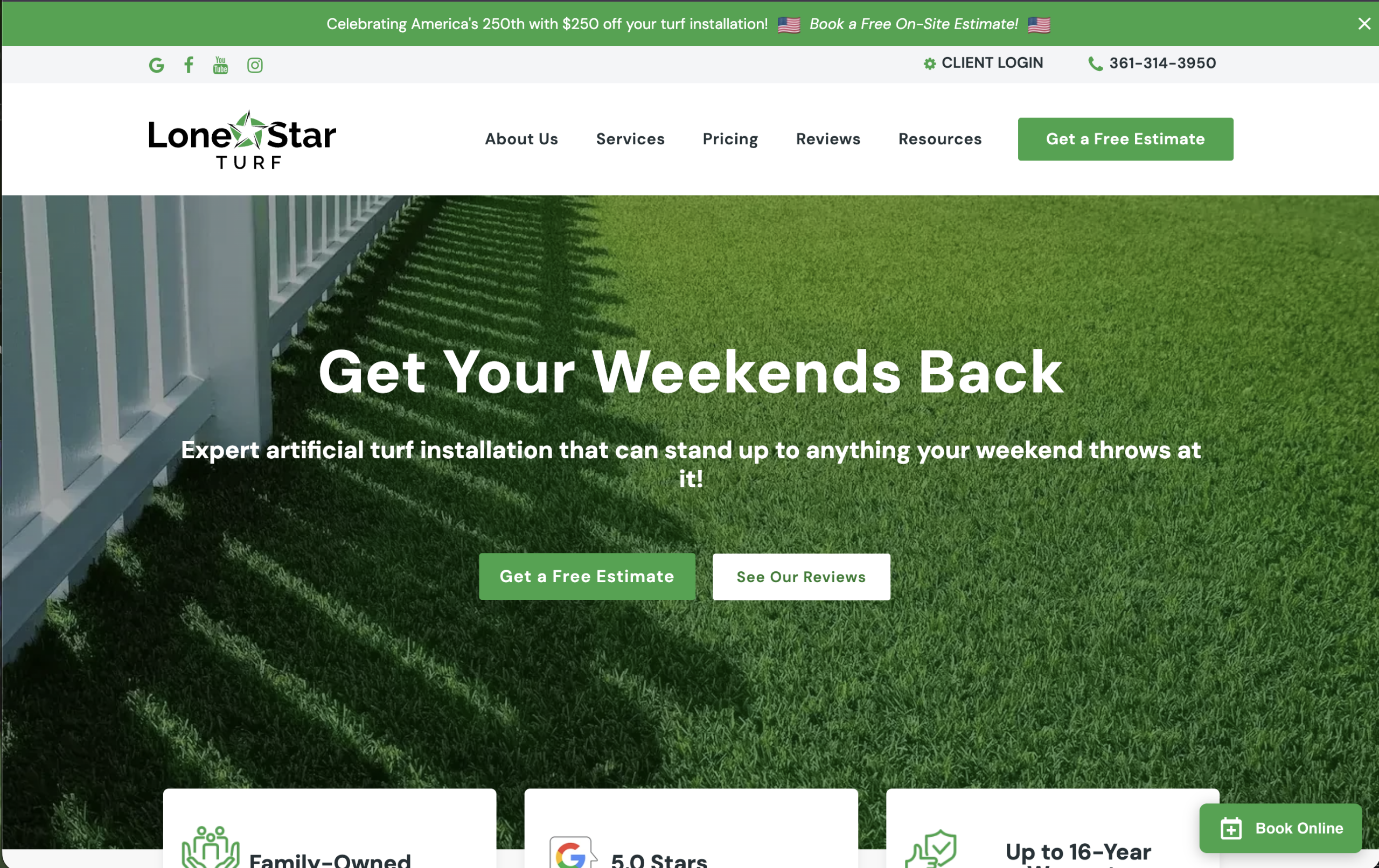
Website: https://lsturf.com/
The Challenge
By early 2025, Lone Star Turf was generating real demand — but the marketing wasn't functioning as a connected system. Paid acquisition was carrying the business while every other channel lagged, and Patrick could see the math wasn't going to hold.
Three problems were compounding on each other:
Organic search had fallen sharply. After several years of solid performance, organic traffic had dropped dramatically year over year. In Patrick's words, watching it "go down and down and down" was "terrifying" for a business actively working to reduce its dependence on paid.
Lead quality from social was inconsistent. An earlier social push generated high volume with low intent. Getting "three, four hundred leads a month" where "95% of them were trash" isn't a growth story — it's a drain on the team and a distortion of the pipeline.
The channels weren't connected. SEO, paid search, and the website were being managed separately. Basic conversion tracking was difficult, and there was no single view of what was actually working or why.
The result was a business with real strength and a real ceiling. Heavy dependence on Local Service Ads and Google Ads left Lone Star Turf one algorithm change away from a bad quarter. There was plenty of activity. What was missing was a strategy — and a connected system the company could own and measure.
The Solution: How We Helped
Duct Tape Marketing began with the Strategy First™ process — building the foundation before touching tactics. No strategy, no engagement. That's not a policy; it's how good outcomes actually happen.
Here's how the engagement unfolded:
1. Strategy First™ engagement
Before any execution started, the team completed a full Strategy First engagement. This produced a defined ideal client profile and a clear picture of the buying triggers that actually drive turf purchases. It clarified core messaging around the company's real differentiator — radical transparency in a non-transparent industry — and included a total online presence audit to find where the system was leaking. The engagement closed with a full Marketing Hourglass map and a set of 90-day priorities.
2. SEO and content rebuild
The real ranking constraint wasn't a lack of content — it was decaying and competing pages suppressing the site's authority. We prioritized fixing what existed before adding new volume, then built a content and search strategy aimed at long-term organic visibility rather than vanity traffic.
3. Paid media optimization
We tightened paid search performance and restored reliable conversion tracking, so spend could finally be measured against real outcomes instead of rough estimates.
4. Owned content and video engine
We built a YouTube and social content system to support the Know and Trust stages of the Marketing Hourglass. Prospects needed a way to experience the brand before they ever called — and video gave them that at scale.
5. A connected Marketing Operating System
Most importantly, strategy, messaging, channels, and reporting were brought into one integrated system — aligned, measurable, and owned by the business rather than scattered across vendors.
The Results
In the first year of the engagement (April 2025 through May 2026), Lone Star Turf saw growth across every major channel.
Search and digital visibility
Organic impressions reached 758K — up 287% year over year — with rankings climbing steadily and more keywords landing on page one
Website sessions more than doubled (+110%)
Pipeline and lead growth
Leads grew 57%, from 3,770 to 5,927
Quote pipeline value grew 65%, from $15.7M to $25.8M in quotes sent
Paid search conversions increased 820% after tracking was restored and spend was properly optimized
Brand and audience reach
YouTube views grew 1,033%
Instagram reach grew 1,671%
Reputation held at 132 reviews and a 5.0 average rating
The channel that was "terrifying" to watch a year earlier became one of the company's strongest growth stories. More importantly, the business is no longer dependent on a single paid channel. It now has an organic engine it owns.
Key Takeaways
Lone Star Turf's results aren't unique to the turf industry. The pattern shows up across home services, specialty contractors, and local premium service businesses that have built real reputations but hit a ceiling on growth.
Activity without alignment doesn't scale. Lone Star Turf had leads, ads, and content — but no connected system. Once strategy defined the direction, every channel got more effective.
Organic search is an asset, not a channel. Paid media rents attention. Organic search builds something you own. The businesses that invest in it during good times are the ones not scrambling when ad costs spike.
Lead quality matters more than lead volume. Hundreds of low-intent leads a month isn't growth — it's noise. The right ICP, the right message, and the right channels produce fewer leads that actually convert.
Strategy before tactics — every time. Lone Star Turf's results compounded because the system was built on a clear foundation from the start. Every downstream decision — content, paid, video — moved faster and cost less because the strategy was already settled.
A connected system changes what's measurable. When channels operate in silos, you can't tell what's working. When they're integrated, you can see it — and act on it.