

Catch the Full Episode:
 Overview
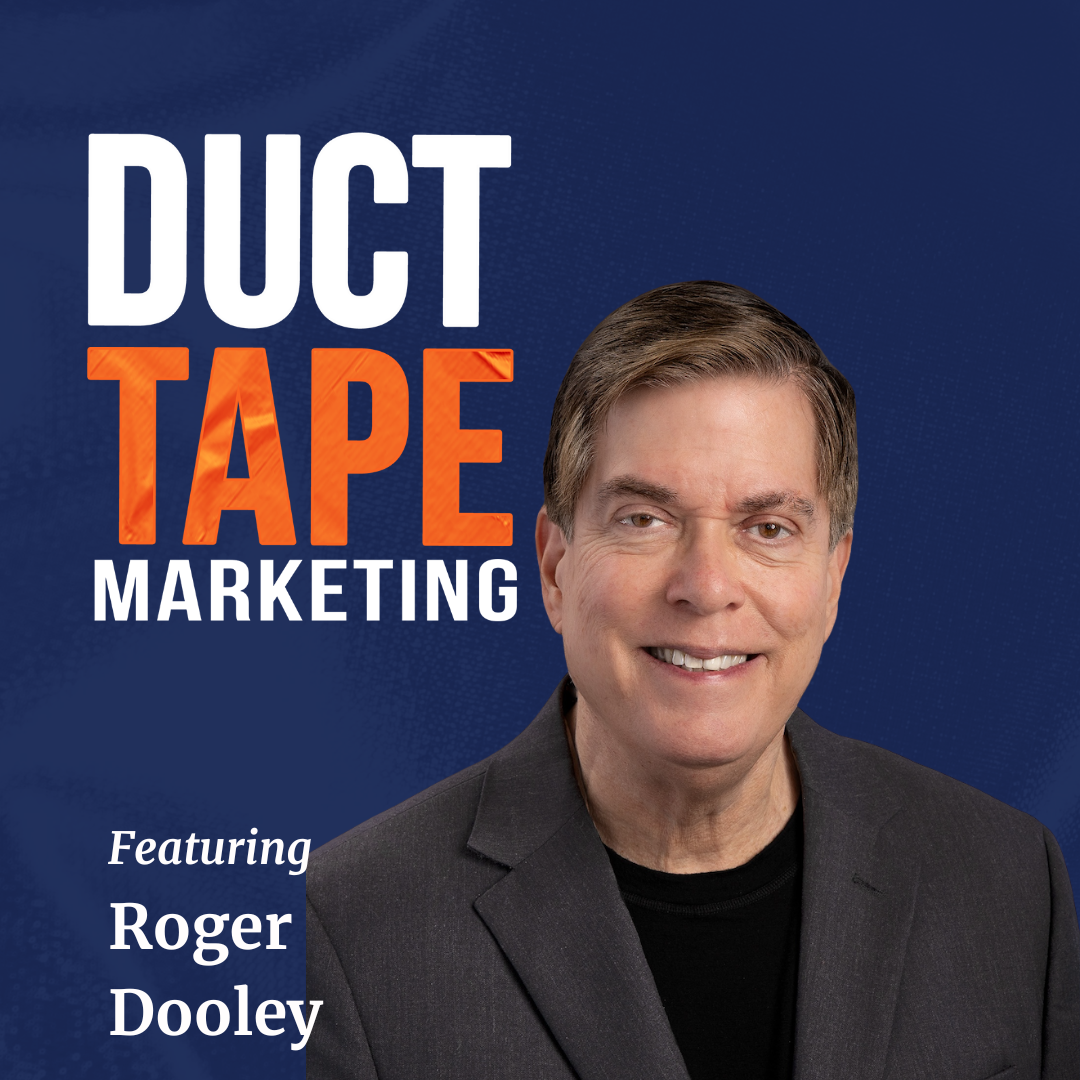
This one’s a throwback from the vault, and it’s aged well given how fast AI keeps moving. Neuromarketing used to belong to companies with big budgets, Roger Dooley says that’s no longer true. In this episode, Dooley returns to the Duct Tape Marketing Podcast to talk about his new book, The Persuasion Engine: How Any Business Can Use AI-Powered Neuromarketing to Understand and Win Customers. He explains why tools once reserved for major brands, like eye tracking and behavioral analysis, are now available to any small business for the cost of a cup of coffee.
Dooley and John Jantsch dig into what he calls the “million dollar team,” using AI models like Claude, ChatGPT, and Gemini to simulate advice from experts like Robert Cialdini and BJ Fogg without paying consultant fees. They also cover a surprising finding: AI models now score higher on emotional intelligence tests than the average human, which means these tools can help business owners write with more empathy, not less.
This episode is for small business owners, marketers, and consultants who want practical, low-cost ways to apply behavioral science and AI to their marketing.
Guest Bio
Roger Dooley has spent 20 years studying neuromarketing and behavioral science, and is known for his work on reducing friction in customer experience. His latest book, The Persuasion Engine, shows entrepreneurs and small business owners how to use AI-powered neuromarketing to understand and win customers. Dooley shares his insights regularly on LinkedIn, where he is most active on social media.
Key Takeaways
- Neuromarketing tools that once required labs and big budgets are now affordable for any business through AI.
- AI models can act as a simulated team of experts, like Cialdini and Fogg, to advise on marketing decisions without the cost of hiring consultants.
- Recent research shows AI models score higher on emotional intelligence tests than the average human, making them useful for writing sensitive communications.
- The most common mistake business owners make with AI is not giving it enough context about their company, customers, and market.
- Test the same prompt across multiple AI models since outputs vary and one may outperform the others on a given task.
Great Moments (Timestamps)
- [01:27] – Dooley explains why he calls this era “neuromarketing 2.0” and how the tools became democratized.
- [05:19] – A Swiss research study showing AI models outperforming humans on emotional intelligence tests.
- [07:36] – Dooley describes building a “million dollar team” of AI-simulated experts like Cialdini and Fogg.
- [09:11] – A case study using AI to analyze a hypothetical pool supply company’s competitors.
- [17:45] – The Duolingo CEO letter that backfired, and what empathetic AI-assisted communication looks like instead.
Memorable Quotes
- “We have entered the era of neuromarketing 2.0, and the big difference is that all of the tools have been democratized.” — Roger Dooley
- “AI is surprisingly good at predicting how humans will feel about a message, even though it can’t feel anything itself.” — Roger Dooley
- “It’s far better to do that as a conversation where you probe and you push back on it, because that’s when you get your real insights.” — Roger Dooley
- “Not having enough context is one common mistake, and the other is not really probing deeply enough, not pushing back, not asking for other answers.” — Roger Dooley
Resources
- The Persuasion Engine by Roger Dooley
- Roger Dooley on LinkedIn
- Duct Tape Marketing
John Jantsch (00:01.614)
So, what if your the buying decision is happening somewhere your marketing never reaches? The tools to understand where that is just became something any business can afford. Hello, and welcome to another episode of the Duct Tape Marketing Podcast. This is John Jantsch. My guest today is Roger Dooley. He's the author of three books that sit somewhere at the intersection of brain science and practical business. Today we're going to talk about his latest book.
The Persuasion Engine, how any business can use AI powered neuromarketing to understand and win customers. So Roger, welcome. I should say welcome back to the show.
Roger Dooley (00:41.003)
Well, thanks so much for having me on again, John. It's always a pleasure to talk to you. You know, I th I think our audiences really overlap, particularly for the new book, because this one is particularly geared to entrepreneurs, smaller businesses that have limited budgets, startups, solopreneurs, and so on, because it's it's really enabling them. But we'll we'll get into that, but I'm really happy to be here.
John Jantsch (01:01.57)
Yeah, yeah, yeah. Well, thank you. So so you've you've been writing about neuromarketing, behavioral science, for I don't know, 20 years, a couple decades. what's changed in the last couple of years that made you write a book specifically about AI? I know partly because editors want books with AI in the title, but but but from your own personal research, is there something about this moment that you think is significant?
Roger Dooley (01:27.839)
Well, absolutely. In fact, you're correct, John. I have been writing about neuromarketing for 20 years, and I've actually come to the conclusion that now we have entered the era of neuromarketing 2.0. And the big difference is that all of the tools have been democratized. When I started on the topic long ago, initially I focused on these sort of hard science type things like measuring brain activity with EEG and so but these tools were only available to the biggest brands. So I kind of pivoted to include.
John Jantsch (01:38.157)
Right.
Roger Dooley (01:56.883)
A lot more behavioral science, psychology. I'm sure that many of your audience know about Robert Cialdini's six principles or seven principles now, and try to apply them. But in any case, the what's happened is not only have the tools for measuring customer reactions, things like eye tracking, for example, used to be very expensive, had to be done in a lab, you had to recruit subjects. now you can even use AI simulations that are very accurate.
John Jantsch (02:04.086)
Sure.
Roger Dooley (02:25.487)
you know the cost as much as a cup of coffee. So you can use them not just on some really big campaign, but you want to see, gee, what, okay, I'm redesigning this webpage. What are people gonna look at? You can get that answer answer instantly. So that that's that's one area. But to me the even more significant areas are, you know, I think that every smaller size business has two big problems, you know, not enough time, not enough money.
and they want to apply things like Cialdini's principles. They want to apply tools the like cognitive biases, loss aversion, and all those tools. But just trying to keep all those in your head at one time is difficult. Just to read Cialdini's book, Influence and Daniel Kahneman's book, Thinking Fast and Slow, is a thousand pages. So, you know, that's that's a lot of that's a heavy lift for most small business owners. But what now you can do, you can use
John Jantsch (03:10.445)
Sure.
Roger Dooley (03:17.947)
the very these AI tools, large language models, Claude, ChatGPT, Gemini, that are available at such low cost to do this heavy lifting for you. And that's what the book is all about. It shows with very specific prompts how you can leverage these tools to suddenly become a sophisticated behavioral marketer.
And then the the last part that I think is really counterintuitive is that it can even help you communicate better with empathy and emotion. You know, we see John, we see even see huge businesses who make these stupid announcements that end up infuriating their customers where their customers revolt, where, we changed our loyalty program. We've made some minor adjustments and then suddenly people are up in arms saying I'm never gonna deal with this company again.
John Jantsch (03:47.822)
Yeah.
Roger Dooley (04:03.294)
You know, and these these companies have sophisticated advisors and they've got PR people, and even then they make these horrible mistakes. But now AI can fix it not just for those not so clue maybe clueless CEOs, but it can help anybody communicate with empathy and emotion. In fact, I just did a short video and article about how even Amish business people who you do not really consider in the vanguard of high tech used AI.
to write more difficult emails like you've got to communicate with a customer who's got a project behind schedule, but they're a big customer and you can't afford to irritate them and lose their business, and how to communicate what has to happen in a way that will land well.
John Jantsch (04:49.794)
You know, it's interesting because I think a lot of people think in terms of of AI and they s they immediately kind of think, yeah, I can do this number crunching and analysis, but you need the human, you know, for context and and for empathy. And you're suggesting actually that that these tools or maybe when directed the right way, right? Directed using some of these frameworks like Robert in Persuasion can actually do a better job than a lot of humans.
Roger Dooley (05:19.312)
Yes, exactly. And believe it or not, John, just last year researchers in Switzerland ran an experiment. They gave emotional intelligence tests, you know, to measure people's emotional intelligence to both humans and to the major AI models of the time. And what they found was that the AI models scored far better on emotional intelligence than the average human. Humans were in like the 60% range, AI was into the 80s. In fact,
John Jantsch (05:28.813)
Yes.
John Jantsch (05:42.487)
Yeah.
Roger Dooley (05:46.225)
the best model was about 89% in emotion for emotional intelligence. That's probably smarter than the most intelligently emotionally intelligent person on most companies' teams. which and now that's last year's models. Today they're even better. So this is really so counterintuitive because I I was with you John I always felt well yeah the one thing that AI will never really master is emotion or empathy. But in fact research shows that it's better. And you can actually try it yourself. Take a
a letter that you wrote that maybe didn't land that well, and and r have Claude rewrite it for you. It will be better than what you did.
John Jantsch (06:24.654)
So you mentioned you actually call something the new million dollar team. I think that I think that's actually a title of one of the chapters that costs less than lunch. Is that right? So what does an AI behavioral science team actually look like? And what what should I expect to pay for?
Roger Dooley (06:45.458)
Right. Well, you know, imag big companies can afford what they call nudge units, where they they hire various types of cognitive scientists, behavioral scientists, and so on to come in and advise them on how to
communicate more effectively how to nudge their customers in one direction, how to increase conversion rate on their website and so on. But you know, most of us can't afford to hire teams like that internally. And so instead maybe we use consultants, but even consultants can be very expensive. Now what
is fascinating. You can create using an AI model like Claude or Gemini, a team of your top experts, whoever you think are the most relevant to your particular project. So you could put Robert Cialdini on there, you could put BJ Fogg, who's the one of the founders of the whole principles of behavioral design, behavior design.
John Jantsch (07:25.441)
Mm.
Roger Dooley (07:36.615)
You could put Dale Carnegie on there if you're in a direct sales situation. You really want to relate to people because he still still has insights that are valuable. you could put a conversion expert like say Peply or Brian Massey to name a few of my Austin compatriots here who are conversion experts, and you can have them work together to advise you on your marketing, to look at your website, look at your landing page, look at the direct mail that you're gonna send out.
and you can get this advice. You can have them discuss it, debate it. And I I get into the details in the book, but it's it's really so exciting to have these different perspectives that are actually being brought together on your particular project without of course having to pay for a bunch of experts.
John Jantsch (08:24.664)
So let's just take a typical example. I've I've got a promotional email I wanna write or a landing page I wanna build or something like that to to sell a product or service. Wha what what's the workflow for that look like now in your you know, in your book or in your platform or your framework?
Roger Dooley (08:43.474)
Right. Well, I've I've got a whole bunch of very specific prompts, but I think what I would start with depends on where you're at. If you've got something that you're trying to improve, you could show that to the AI and ask it to critique it from various perspectives. You could ask it to look for friction. Of course, you you know, I'm I'm the friction guy too, or I talk about how making things easy is better. And that we all put these barriers in our on our websites and other processes we don't really think of as being barriers or difficult, but to a new customer.
John Jantsch (08:59.862)
Yeah, yeah, yeah, yeah.
Roger Dooley (09:11.978)
they do look like a barrier of some kind. So you could have it do those kinds of analyses. then you could have it suggest different behavioral principles for interventions that would work better. You know, do we need social proof or do we need authority? and you can also have it go out and analyze your competitors, see what your competitors are doing, and use those ideas to
improve yours and also see where they're falling flat. one of the stories I relate in the book is a I did a just an experiment for a local pool supply company. I created a hypothetical pool supply or pool service company.
And had it do an analysis for my little local market here on the west side of Austin. And it came out and identified all the competitors. It found their websites. It looked at their reviews on Google and Yelp and so on. and it looked, it analyzed their websites and found some really strange things. In one case, it found that this one competitor had this comparison chart. And this was like on a not on their home page, it was on a deeper page in the website that showed us and our competition. and it was really wild where
You know, we don't peek in your windows, we don't pee in your pool. And you know, it's like all these crazy things that it said, okay, this is what your this competitor is doing. So and it pointed out that this is probably going to turn off more people than it's going to help, unless they've had those specific problems, but which which aren't really typical of pool service companies. But it could it could analyze what they're doing and then advise you on how to position your company to compete better.
John Jantsch (10:17.282)
Huh.
John Jantsch (10:33.996)
Yeah. Right.
John Jantsch (10:42.35)
So how do you you know it's one thing to add, like you mentioned all the folks, I mean, we'll come back to Cheraldini or you know, all the folks that you mentioned. So you build all this like, I think these are the best of the best. But how do you then tune that? You know, I my brand voice might not be Dale Carnegie, and it would actually sound inauthentic. I'm just using that as an example. So, you know, how do you how do you tune how do you take that framework that those folks presented, but then put it in your voice?
Roger Dooley (11:12.442)
Right. Well, actually, what you're bringing up there, John, is a bigger picture which falls into the context area, providing your AI model with context about your business. and so first of all, for your voice, you can give it a whole bunch of your past communications, writing, and so on, and it can learn your voice. And there there's techniques for doing that, but also you can talk about your positioning, your customers, where you want to be. If you're at the high end of your market.
John Jantsch (11:19.394)
Right, right, right.
John Jantsch (11:29.388)
Yes.
Yeah.
Roger Dooley (11:41.081)
and you're trying to create create a specific image, then obviously the AI has to know that so it can give you better advice. You can provide it information about customers that and it can help you develop customer profiles too. You know, it could I think in in general one piece of advice I have, John, is people type a command into an AI, a prompt, and then say, okay, I got my results.
It's far better to do that as a conversation where you probe and you push back on it because AI wants to please you and it'll give you answers you don't like, but push back on it, say, okay, well, why are you doing this? Would this other thing be better? Or what about this other concept I had? and when you make it, when you push back and ask more questions, that's when you get your real insights.
John Jantsch (12:02.573)
Mm-hmm.
John Jantsch (12:09.134)
Yeah, yeah, yeah.
John Jantsch (12:14.904)
Yeah.
John Jantsch (12:26.296)
We're c we're entering, you know, AI has been around enough to where it's, you know, certainly hit mainstream. There's very few people you can come across anymore that haven't at least played with it or toyed with it. But a lot of business owners are have actually been genuinely disappointed with the results that were promised, or or at least they thought you know, the hype promised them based on what they actually got. What do you what do you think they are actually what what are they typically doing wrong if they're getting disappointing results?
Roger Dooley (12:56.318)
I would say most commonly it is not providing enough context for one about the company, the customers, the marketplace, not pushing the AI to develop part of that context because you could have it go out and do the surveys. What's the competition doing? What's my market like? What are the factors affecting you know my specific market at this time? And your AI can develop some of that knowledge for you. and you can create a whole document. Like I one AI I like is.
John Jantsch (13:01.006)
Right.
Roger Dooley (13:26.252)
Perplexity for deep research. If I'm going to do a lot of research on a particular topic, maybe I'm going introduce a new product and I really want to learn all I can about the product, the market, and whatnot. You can use any of the models. Perplexity is one, but also the others do deep research. You can have it create a 20-page report, which you can then use for context in preparing your model. So I would say that not having enough context is one common mistake.
John Jantsch (13:33.655)
Mm-hmm.
Roger Dooley (13:52.839)
And then the other is not really probing deeply enough, not pushing back, not asking for other answers. And there's something else that I highly recommend is always trying this with more than one model. You know, right now they're cheap enough that you don't have to just adopt one and stick with that one. If I'm doing something important, I'll ask Claude, which is my sort of number one go-to, but I'll ask Gemini and I'll ask ChatGPT as well. And sometimes I get not much better insights once in a while. I was looking for a tagline for something, I forget what.
John Jantsch (14:05.09)
Yeah. Yeah.
Roger Dooley (14:22.458)
And the first two models I tried came up with pretty good stuff, but it wasn't quite there. And the third one, for whatever reason, just happened to hit on one that wasn't quite right in itself, but by changing one word, then I had it. And I said, okay, bam, this is it. But it that only happened because I tried three different models. And of course I used a little bit of my own knowledge and intuition as well.
John Jantsch (14:34.925)
Mm.
John Jantsch (14:41.997)
Right.
Yeah, it's it it is kind of amazing how it almost feels like day to day. It's like they have temperaments. It's like you get better better output out of one one day and b different output out of one the next day. It's I think it's part in due to that they're changing so rapidly as well.
Roger Dooley (15:01.162)
Well, they're definitely evolving. And sometimes the newer model isn't necessarily exactly as what you were looking for compared to the previous model. But you know, you still you can adapt and they are getting more and more powerful and they're getting better, fewer hallucinations, they're be getting better at self-checking. So before they give you an answer, they'll check it sometimes. And or you could it should always prompt it to check the answers too. And especially if you're creating any kind of a document that you're gonna say send to a customer.
John Jantsch (15:15.852)
Yeah.
Roger Dooley (15:27.27)
run it through a check and say, okay, be sure that everything that I'm providing here is actually true. You know, we we've all heard those stories about the lawyer who filed briefs with the hallucinated cases. And th that that's a serious issue.
John Jantsch (15:36.238)
Yeah, yeah.
Yeah, yeah. I I I've actually noticed w w we use cloud predominantly as well. And I've actually noticed sometimes as it's putting together output, it will actually correct itself and set and say, I made a mistake on that. Let me go back and I mean you can see it in real time actually doing that kind of thinking. So I I think they definitely are are building that in.
Roger Dooley (16:02.608)
Right. Yeah, that's better than it coming back and saying, Yeah, Roger, you caught me on that. I was wrong. Yeah, I shouldn't have had to catch you, you know?
John Jantsch (16:09.014)
Yeah, I yeah, that always frustrates me as well. What one of the things I think I read that I particularly picked out this line that you wrote that AI is surprisingly good at predicting how humans will feel about a message, even though it can't feel anything itself. talk a little bit about that from a practical standpoint if I'm writing a sales page or a pricing page.
Roger Dooley (16:33.768)
Right. Well, you know, we already talked about or we mentioned the idea that AI scores better on emotional intelligence than humans because it has consumed so much knowledge about human emotions. It's read novels, it's read science scientific papers. And so it understands emotions fairly well. And if you prompt it properly, you can get it to see those sort of emotional blind spots that you miss because
John Jantsch (16:43.832)
Yeah. Yeah. Right.
Roger Dooley (16:59.602)
We all know what we know and we think our customers know. We think we know how they're gonna react. And sometimes we do like and certainly there are exceptionally skillful salespeople and leaders who have that intuition about how customers will react. Maybe Steve Jobs, you know, say, no, no, yeah, don't worry, you know, nobody's seen this thing before, but they're gonna love it.
John Jantsch (17:04.29)
Yes.
John Jantsch (17:11.468)
Yeah.
John Jantsch (17:18.37)
Yeah.
Roger Dooley (17:18.588)
you know when it comes up with the iPhone. But you know, most of us don't fall into that savant category. And we think we're sending something a communication that's going to be easily understood and accepted the way we mean it. I mean a couple of examples I've got are one when the Duolingo CEO sent out a letter which is that was supposed to be very uplifting it was that they're becoming an AI first company you know and this it sounded really exciting and positive.
John Jantsch (17:23.662)
Mm-hmm.
John Jantsch (17:42.412)
Mm.
Roger Dooley (17:45.714)
Unfortunately, the way people interpret it was, okay, the employees are thinking, man, the robots are coming for our jobs now. And so it ended up being a demotivator, and they had he had a backtrack and say, no, that wasn't what I meant. and you know, these things happen all the time. And you know, these aren't these aren't dumb people. It's just that sometimes the way we think our words are gonna land doesn't work. And I've in the I've got a I'm not gonna go into the details, but a great story about a communication to luxury cruise line passengers who
John Jantsch (17:52.183)
Yeah, right.
Roger Dooley (18:14.588)
got a letter in their cabin about a departure an arrival change that totally screwed up their flights beat for a corporate photo shoot and the
John Jantsch (18:23.638)
Mm.
Roger Dooley (18:25.802)
so these luxury passengers were suddenly having to scramble for flights in the middle of Florida spring break when there's no flights, there's no hotel rooms. and the way that was communicated was in such a tone-deaf way. There was not not even an apology. there was a brief acknowledgement that if you incur extra costs, we'll reimburse them if they're reasonable. And you know, it missed the whole point of empathy saying, okay, these are your people who are attached to your brand. They love your brand, and you're doing this to them.
you know you've got to let them know that you care and I I ran it through Claude and it created a far first of all it said don't do this if it hasn't been done. This is a terrible idea. You're gonna damage the brand but it then created a a much better letter that if you do have to create a crew do this thing then here's how to communicate it and it was just infinitely better than the one that the whoever wrote it at that cruise line wrote
John Jantsch (18:56.227)
Yeah.
John Jantsch (19:19.468)
Yeah, that's probably delivering bad news is probably the hardest thing for most people to be able to communicate because it's just, you know, there's so much emotion built into like I don't really want to send this even. So if somebody's listening and they want to run their first behavioral audit on something they're working on, what's the what's the first thirty minutes hour look like to run that audit?
Roger Dooley (19:45.518)
probably a series of prompts to first, you know, add the context about the company, add the existing marketing materials that you're trying to audit, if you're trying to you know, that's if that's your goal, and then choose your experts or even have, you know, one thing that I I always like to do with AI is if I'm not sure where to start, I will ask Claude or Gemini, okay, here's my objective. how should I start? What do you need for me?
John Jantsch (20:08.877)
Yes.
John Jantsch (20:12.716)
Yeah. Yeah.
Roger Dooley (20:13.613)
And the other thing, you know, in the book I did not append this to every prompt, but in the I I did create a little mini website on my own website, RogerDooley.com, that is there's a link in the back of each at the end of each chapter where I've got copy and paste prompts so people don't have to type in you know, lines and lines of text from the book. That that'd be pretty brutal. And also some improved prompts.
John Jantsch (20:32.482)
Hm. Right. Yeah.
Roger Dooley (20:39.875)
that are go sort of go beyond what I could really include in the book because nobody wants a book that's full of pages of prompts. But the the what I was going to point I was making is that I do recommend adding ask any questions that will help you respond every any time you prompt an AI, just add that little phrase and often you will get a few questions back that'll it greatly improve the output that you're getting.
John Jantsch (20:45.872)
Right, right.
John Jantsch (20:57.4)
Yeah.
John Jantsch (21:05.388)
Yeah, I I concur wholly on that one. Well, Roger, I f appreciate you taking a few moments to stop by a DuckTake Marketing podcast. Is there somewhere you'd invite people to learn more about your work and obviously learn more about the persuasion engine?
Roger Dooley (21:20.873)
Sure. the best place to start is RogerDoley dot com. easy to find. and also I'm happy to connect with any of your audience on LinkedIn. that's where I'm probably most active on social media is LinkedIn. I post fairly frequently and I interact quite a bit there.
John Jantsch (21:36.566)
Awesome. Well again, I appreciate you taking a few moments to stop by and hopefully we'll run into you I guess next time I'm in Austin.
Roger Dooley (21:43.324)
I hope so, John. Take care now. Thank you.
John Jantsch (21:44.682)
Sorry, take care. Mm-hmm.
Sign up to receive email updates
Enter your name and email address below and I'll send you periodic updates about the podcast.