
Catch the Full Episode:
 Overview
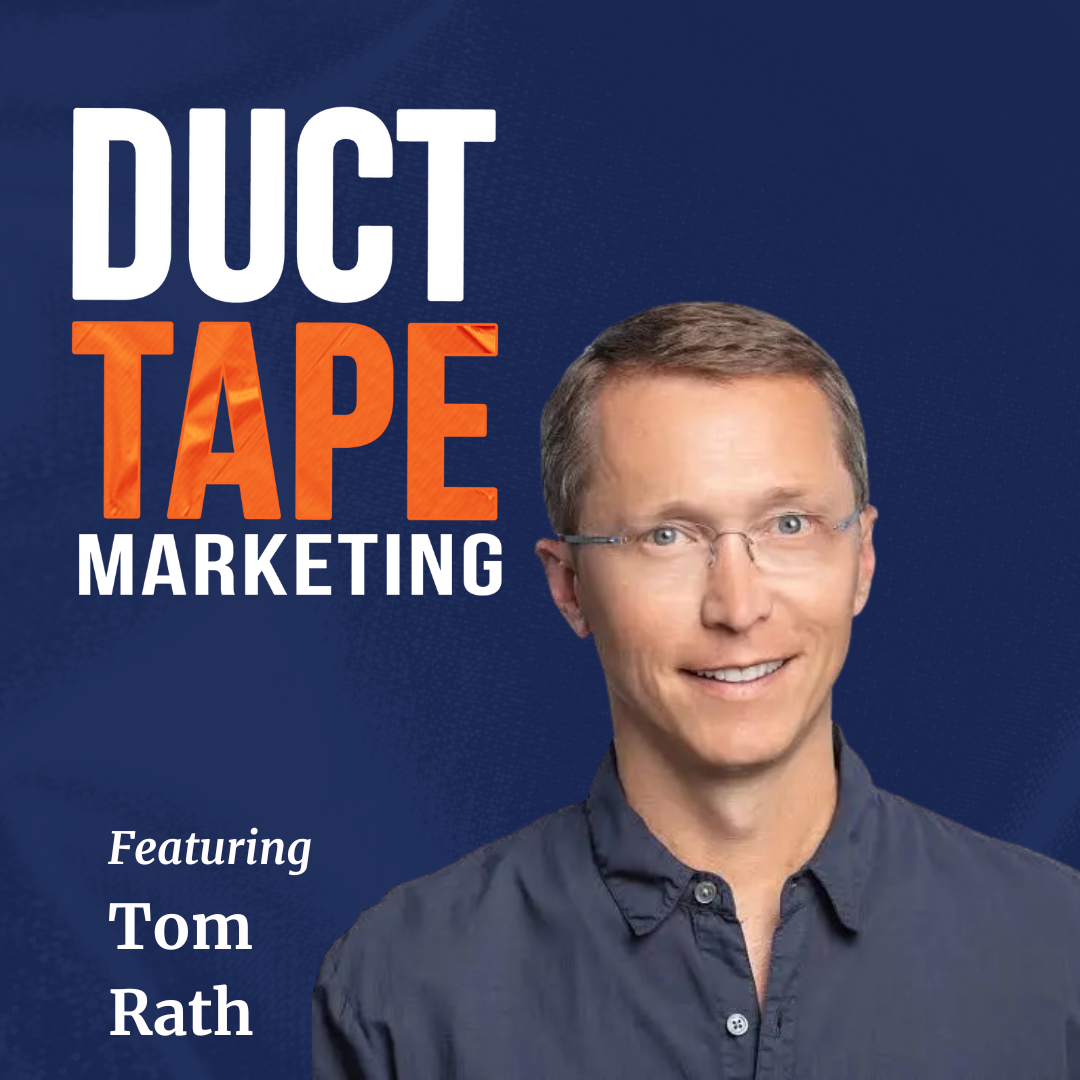
Most small business owners are not stuck because of strategy. They are stuck because they have drifted away from a clear answer to one question: what is the point? In this episode, John Jantsch sits down with Tom Rath, bestselling author of StrengthsFinder 2.0 and Eat Move Sleep, to explore why purpose is not a grand philosophical destination but a practical tool you use every hour of every day.
Tom draws on decades of research at Gallup and his own experience navigating a life-threatening genetic condition to make the case that meaning is not optional. It is the thing that separates people who build something lasting from people who are simply going through the motions. And with AI accelerating fast, the motions are exactly what will be automated first.
This episode is for business owners who feel quietly stuck, leaders who want to build teams that actually care, and anyone who suspects that the way they are spending their days does not quite match what they would say matters most.
About Tom Rath
Tom Rath is a number one New York Times bestselling author whose books on strengths, wellbeing, and contribution have sold more than 10 million copies worldwide. He began his career at Gallup, where he helped develop the strengths-based tools used by millions of people globally. He is the co-founder and CEO of CareerSight and the author of What’s the Point, out now. His other titles include StrengthsFinder 2.0, Eat Move Sleep, and Life’s Great Question. Learn more at tomrath.org.
Key Takeaways
- Purpose is not a destination. It is a tool. Stop treating it as a big existential question you answer once and start using it to prioritize every hour of every day.
- AI will replace the people going through the motions first. Routine, responsive, eyes-down task work is exactly what large language models do well. Builders, initiators, and creative thinkers are far harder to automate.
- Reserve at least 20 to 30 percent of your day for work that will matter a week, a month, or a year from now. If you cannot point to any of it at the end of the day, something needs to change.
- Financial outcomes are a poor north star. The research on wellbeing is consistent: the more you treat income or status as the primary measure of success, the less satisfied you are likely to be over time.
- Do the meaningful work first. If you save it for later, it will not happen. Protect your best hours for the things that matter most, and push responsive work toward the end of the day.
- Your energy is a business asset. Small business owners are often the worst at protecting their own wellbeing. The tone you set becomes the norm for everyone around you.
- Turn purpose outward. One of the most effective habits is spotting what someone else is doing well and telling them where they made a difference. It helps them and tends to come back to you.
- Young workers are not entitled. They want meaningful work. That is a healthy evolution from the industrial era model of work as a means to an end, and smart leaders will build for it rather than resist it.
- Start with what the world needs, then map back to who you are. Self-awareness matters, but it only gets you so far without understanding what your clients, your community, and your market actually need from you.
Timestamps
[00:01] Opening hook: the quiet drift away from one simple question is what keeps most business owners stuck.
[00:57] How everything Tom has written about strengths and wellbeing led him to write a book about purpose.
[03:47] Tom’s personal health journey and why a life-threatening diagnosis at 15 shaped how he thinks about time.
[05:33] Why he almost titled the book around the word purpose and what stopped him.
[06:32] How this connects to small business owners specifically, and why the question is more urgent now than a year ago.
[08:39] What the research actually says about chasing income and status as primary outcomes.
[10:18] The relationship between asking what is the point and employee engagement.
[13:57] How to actually get to it: practical steps for building purpose into a workday.
[16:09] The counterintuitive first habit: sleep as the reset button for everything else.
[18:13] Why unlimited vacation policies often produce no vacation at all.
[19:08] How younger generations entering the workforce are changing what meaningful work looks like.
[21:25] How strengths shift as people advance in role and responsibility, and what that reveals about how we develop.
Memorable Quotes
“We always say we’ll have tomorrow. Take it from somebody with life-threatening conditions: you don’t. You never do the stuff you put off till tomorrow.”
“If you’re just the responder, there’s a cloud update coming for you.”
“Purpose unlocked was the working title. I realized we have a semantic challenge. When most of us hear the word purpose, we think of some big grand thing that’s almost intimidating.”
“It’s not like my grandfather’s generation where the job was just a means to an end. People who are 25 expect to have a job that makes a difference in the world. I think that’s good.”
“Start with what the world needs, what your community needs, what your clients need, and then map back to how you can do that well based on who you are.”
Learn more about Tom Rath and his work at tomrath.org.
John Jantsch (00:01.249)
So what if the reason so many small business owners feel quietly stuck, even when the numbers look fine, is not burnout or strategy, but the slow drift away from a clear answer to one question, what's the point? Hello and welcome to another episode of the Duct Tape Marketing Podcast. This is John Jantsch and my guest today is Tom Rath. He's the number one New York Times bestselling author whose books on strength, wellbeing, and contribution have sold more than 10,
million copies worldwide, including Strength Finders 2.0, Eat, Move, Sleep, which we did an episode on this show. Tom started his career at Gallup where he helped build the strengths-based tools used by millions of people. He's now the co-founder and CEO of CareerSight and his new book, What's the Point, is out now. And we're going to dig into why that question matters more than most of us want to admit. So Tom, welcome back to the show.
Tom Rath (00:55.406)
Good to see you again, John.
John Jantsch (00:57.215)
So how is everything that you've written about strengths and wellbeing and contribution kind of made this question, what's the point, something you need to spend a whole book on?
Tom Rath (01:08.758)
Yeah, you know, it's interesting. I realized in my own life and in teams and leaders and people that I'm working with that it's gotten so easy to just go through the motions in a given day because it's I mean, it's almost easier to just feel like you get to inbox zero and you respond to the things you're supposed to respond to your finish your day's tasks. You do your expense reports, you get home and then you catch up with some of your family members. You let a show play on Netflix, let the next one go and you just kind of
become a little more passive in terms of the way you're kind of going through days in life. And that's almost more enjoyable and easier to do sometimes. And so I think we need to, especially with all the automation and everything coming our way right now, we need to do a little bit better job. And at least I realized that I did of kind of shaking myself out of that routine and saying, are you dedicating some time to more creative pursuits? Are you building things? Are you investing more?
deliberate time in relationships and conversations with people that matter so that at the end of the day, you make sure that you reserved at least, I don't know, 20, 30 percent of your time at a minimum for doing things that might really matter a week from now or a year from now or maybe even a decade from now. asking what's the point, not as some broad philosophical sunny day once in a lifetime question, but more as a light for how you prioritize every hour within a day.
is what caught me and has really helped and worked pretty well.
John Jantsch (02:38.359)
Yeah, and I think that's true of many small business owners. mean, the crushing noise seems to take over. if you can, see lots of people advise this, if you can get in the habit of saying, what's like the one thing that if I did that today, that would move the needle instead of all this other garbage, which 80 % of is probably just busy work. So it's not, like you said, it's not just self-development. I mean, it's a very practical business tool, isn't
Tom Rath (03:06.338)
Yeah, and I think that one of the very just I'm always looking for those practical tips and tools from the research. But what I figured out is if you can try and restructure or reprioritize the order in which you do things in a given day so that you ensure that you're not going to go a day without working on some meaningful purposeful items that and that can just be having a 15 minute conversation with someone who works for you and really listening and closing your mouth and giving your device stowed away and investing in someone's development and then realizing that
That kind of is the point and that is the purpose. And that's not a waste of time because it's it's those kind of trust and relationships that really build speed and efficiency and creativity and innovation over time.
John Jantsch (03:47.447)
So many people, there's lots of stories of people being kind of woken up to this idea by something that happened. You've been very open about your own health journey. How is that, in fact, you're one of your last books. We talked about that on the show, but how much has your personal experience sit underneath this new book, you think?
Tom Rath (04:08.33)
It sits under this new book to a degree where, I mean, I probably realized much earlier on because I was told I had a debilitating genetic cancer syndrome when I was 15 that I needed to try and pack more life into those years than a lot of people think about pretty early on. But one of the things I realized when I worked on the book about health, Eat, Move, Sleep, that you mentioned was that even with all those big threats to my health and I had active tumors in my kidneys and pancreas and spine and all over,
That wasn't a very good motivator to skip the cheeseburger and french fries at lunch and to get a salad instead. that research I did on health kind of taught me that we all need better ways to just give ourselves short-term incentives throughout the day to do things that matter and that make a difference because just knowing that in the end the eulogy virtues will matter more than the resume virtues as David Brooks described it, that doesn't stick with me at least.
to change the priorities of what I'm doing within eight hours that I'm working in a day. But what can shift that is when I'm able to connect back an hour that I spend editing a draft with the difference that will make for someone who can read something faster without all the kind of extra bloated sentences and fluff and all the things around it and realizing that that is a part of why I'm doing what I'm doing. And so I think...
You know, one of the things is I started to work on this book that hit me. I hope at the right time is I was going to title the book around the word purpose. I think it was purpose unlocked or something like that. And I realized that right now we have a semantic challenge where when most of us hear the word purpose, we think of some big grand thing that's almost intimidating and it gives us anxiety when in reality we kind of need to learn to just make purpose a part of our toolbox that we.
John Jantsch (05:43.693)
Mm.
John Jantsch (05:53.675)
Right.
Tom Rath (06:02.904)
tap into and use every hour throughout a day essentially. And it can be something pretty pragmatic.
John Jantsch (06:08.661)
It's funny as I listen to you talk about the editing of the draft. had an editor that, that used to tell me, why are you doing all this throat clearing? You know, like get to the point. that's always stuck with me anytime I find myself running on. so you've spent a ton of time in, very large companies, lot of the research and, done at Gallup. I would say that.
Tom Rath (06:22.392)
Yeah.
John Jantsch (06:32.641)
this idea of what's the point. I'm not saying it's exclusive to small business owners, but I've worked with a lot of entrepreneurs. And I think that that question just almost haunts them a lot of times. Do you find that this work is maybe more appropriate for one audience or another?
Tom Rath (06:42.03)
Mm-hmm.
Tom Rath (06:50.594)
I think in smaller businesses that I've been a part of and startups, there's more of a natural and healthy tendency to be asking that question to say, well, what's the point of doing this or we're wasting time doing this. And as you get bigger and as more layers come in, it's a lot easier to have larger groups of people or teams or people on a team who are essentially sleepwalking through a lot of their days. And I think whether you're in a business, large or small,
One thing that's hit me as I've started to have more conversations about what's the point is that I really do think when you look at what AI and automation can and will do not three years from now, but six to 12 months from now, it's the places where people are just going through the motions and responding and doing routine eyes tasks that can easily be done by a machine that will be taken out most rapidly. So I, I've
I've learned more urgency about this question in the last six or 12 months is the tools that I use have gotten so much better. So I think it's going to become maybe a more qualifying and pressing question as well, because I would have been hesitant a year ago to tell people that they need to be builders or they need to be creative or they need to be initiating instead of responding, because I kind of saw that as the purview of some people and not others in my traditional world. But I don't...
John Jantsch (07:54.37)
Yeah.
John Jantsch (08:09.101)
Mm-hmm.
John Jantsch (08:14.295)
Yeah.
Tom Rath (08:17.868)
I don't think that can be the case anymore because if you're just the responder, there's a cloud update coming for you.
John Jantsch (08:25.697)
that's going to do it better than you. That part of it, yeah.
Tom Rath (08:27.682)
Right. I I looked at when I got out of college, I was trying to be a McKinsey consultant or an Accenture consultant. And 99 % of what I was aspiring to do could be done better today by one of by a large language model. Right. It's wild.
John Jantsch (08:39.937)
Yeah. Yeah, absolutely. I mean, I think AI is going to force the point of what's the point might be the only point, you know, really for people that can actually address that. You know, if you ask a lot of people starting a business, they would say the point is, well, make money to have status or the big one to have freedom. You know, the joke's on them on that one. But does your research suggest that the real answer is different?
Tom Rath (08:48.355)
Yeah.
Tom Rath (09:10.112)
Yes, all of the research that I've studied on well-being and positive psychology and kind of workplaces and life satisfaction over time would suggest that the more you treat and put financial status or raw income as kind of the outcome or dependent variable that matters in your life, the less likely you are to be satisfied in terms of where things come out at the end of your life because
There's that kind of hedonic treadmill that researchers talk about where you're always chasing another, whether it's you think another doubling income might make you twice as happy, but in reality that might get you 5 % and you spent twice as much time chasing it.
John Jantsch (09:53.453)
So we've spent a lot of years, last 10, 15 years, where engagement, employee engagement in particular, was a real big metric for employers to say, I'm being successful. Is there a gap between people who are addressing this, what's the point? Do they tend to be more engaged or do they tend to be less engaged or is there a gap that you can actually identify and measure?
Tom Rath (10:01.869)
Right.
Tom Rath (10:18.648)
I think it's kind of asking what's the point in moving with purpose is kind of a definitional component of engagement to me because it means that you're in tune with why you're doing what you're doing throughout the day. I think disengagement to just broadly kind of stereotype what that is, especially that active disengagement people talk about, is when you're either actively frustrated with your job or you're just kind of letting it pass by.
I'm more concerned about people in that sort of neutral state being blindsided as innovation starts to move at the clip it's moving at right now. So I mean, I hope that for friends and family members and people that I care about that we can kind of find ways to snap ourselves out of that and do things with a little bit more intent and purpose in a given day.
John Jantsch (11:12.823)
So many people spend a, I mean, if you throw out sleep, the time they spend at work certainly dominates a lot of how they spend their time. Is it important, do you believe, to have some connection to meaning? Like I'm making a difference, what I'm doing is making a difference in your work for you to really kind of have that what's the point answer?
Tom Rath (11:37.772)
I think so. don't, if there are things that you're doing in the span of a given day that when you really think about it, don't improve the lot in life of another human being or make them a little bit better off. So if you're working as a barista at Starbucks and you have a customer that comes in and she's having a real tough day or kids are dragging on or asking her questions and you take her from a day that's a negative five to neutral, that's a...
pretty big contribution that makes a difference and you need to step back and acknowledge that in the moment or ideally have a manager that acknowledges that and helps you to see it too, right? So I think that is if you're not making those connections and you're like if I'm spending an hour of my day responding to cold emails from people I don't even know or it's not making a difference, that's an hour that's taken away from a good conversation with someone who works for me.
or one of my kids at the end of the day that could be pretty meaningful. And so I think to kind of think about that trade-off in terms of how you allocate your hours has been really helpful too.
John Jantsch (12:40.223)
Yeah, so the message is don't reply to email. Just let it pile up. That's... There you go.
Tom Rath (12:43.768)
Don't reply to pointless emails. And I would say save the responsive stuff for the end of the day if you can, or later in the day where make sure you pump the meaningful stuff in early on or it's gonna get away. We always say we'll have tomorrow and kind of take it from somebody with me with all these life threatening conditions, you don't. You never do the stuff you put off till tomorrow.
John Jantsch (12:50.529)
Yeah, Yeah, right.
John Jantsch (12:56.247)
Yeah.
John Jantsch (13:02.764)
Yeah.
You wrote a book called Life's Great Question. Is this an extension or does this push up against that idea?
Tom Rath (13:12.024)
Well, you know, it's interesting life's great question was kind of about the contribution and other orientation at a pretty high level. so, you know, as I tried to the first book I wrote 25 years ago was called How Full Is Your Bucket? And that was the most kind of just dead simple pragmatic thing, because you get the whole thing in the book's title. Every time you talk to somebody, it either fills their bucket or it takes from it. There's no neutral in between. And you can kind of apply the concept if you don't even read the book description.
Right? And that's, so that's what I was trying to get to with bringing some practice to purpose and meaning and these things that we all want and we think we want to get to in life. But how do you just do it in the next hour or on a Wednesday morning? Right.
John Jantsch (13:57.613)
Okay, so I don't think there's too many people listening, at least listening this long today, that would argue that this is a very important step, a meaningful step, and makes total sense. But how do get to it?
Tom Rath (14:11.79)
Well, I think you get to it by saying, when you step back and look at what we all do for a living, that you mentioned like kind of outcome. if I would argue the outcome is not making more money and the outcome is not more titles or a better title and the outcome is not more followers and some of those kinds of superficial things that you can chase endlessly forever, even if you have a billion dollars. So if you agree with that.
John Jantsch (14:35.2)
Mm-hmm.
Tom Rath (14:40.918)
And you say at the end of your life, I'd rather be a good dad, a good spouse, a good member of my community, someone who ran a business that mattered and a good manager and a good leader and a good mentor. If those are the things that matter, then you almost have an obligation to figure out how you build that into the way you execute your job and the way you lead people and what you're doing in life. And that's not something that you can just say. And it is because it is.
It's something that you have to pump into the conversations you have with the people who work for you, the people who look to you for leadership to spot what they're doing, to tell them where they make a difference. And that's been one of the most powerful strategies I've seen work in this regard is where you can turn that outward and help spot someone else doing something that's meaningful, spot one of their talents that they hadn't noticed. And if you just work on doing that in an outward manner, that's, it makes an immeasurable difference for other people and you kind of pick it up.
in the process as well.
John Jantsch (15:41.111)
So do you have, in this work, do you have a series of, know, sometimes it just takes exercises, you know, to form habits, because I do think a lot of this work is habit, just like you get into busy work and having too much to do is somewhat a habit. Do you have some techniques or practices that you've used to help people break those bad habits and maybe establish a habit that centers them back into this important question?
Tom Rath (16:09.74)
Yeah, you know, I think this is going to sound a little counterintuitive based on what we've been talking about, but I would say the first anchoring habit that I would recommend for anyone listening is to make sure that based on what time you need to wake up tomorrow morning, that you work back from that by eight or nine hours or how many hours you need in bed to get a good night's sleep. And you make sure you get a solid seven or eight, because that's the reset button on the video game that's our life. And then you get up the next morning.
John Jantsch (16:31.958)
Mm-hmm.
Tom Rath (16:37.408)
And you're going to have a lot more energy to say, how do I wake up and tackle things that are more meaningful and more purposeful early on and structure my day so that by 10 o'clock by noon, you ensure that you've had some of those meaningful conversations. You've worked on a project that might continue to make a difference for someone a year from now, or at least a week from now. And to structure your day so you kind of have the ebb and flow of energy and you're more active.
You get things done. have energizing conversations with people and to think about it that tactically. So how do I build the cadence and momentum of that of my day so that I have the opportunity to be my best? And then you allude to this too, where small business owners and leaders are often the very worst at making sure they put their own energy at the forefront and they end up kind of burning out, working longer hours than they probably should.
The small business owners, and I'm one of them, that have done that, I mean, there's this tendency to say, it's okay for me, even though I want my people to have wellbeing and to take a vacation where they're not responding and all that. That's not realistic. If you're doing that as a leader, it sets a tone that it's not socially acceptable for everyone else. So I think we all have to do a little evaluation in the mirror about...
John Jantsch (17:45.463)
Yeah
Tom Rath (18:01.836)
the expectation we're setting for the people in our business, the people we lead, and then do better job of modeling that as leaders as well. So that's another piece of the kind of practical step I'd encourage people to think about.
John Jantsch (18:13.995)
Yeah, I have kids that have worked in large corporations. It was kind of trendy a few years ago to have the unlimited vacation. Like, you don't have three weeks off vacation. And so consequently, nobody took vacation.
Tom Rath (18:25.09)
Yep. I've worked in places where it's unlimited vacation is no vacation and no time off. Yeah.
John Jantsch (18:30.477)
It's funny. So I don't know how much access you have to Gallup data anymore, but I'm sure at some point you had a lot of access to it. Would you, if you had to predict or maybe again, as I said, you've seen the data have the strengths finders outcomes changed dramatically as you people view work differently than maybe they did 15, 20 years ago. Do you, do you think that that like
what people value and even the traits that come up as their strengths would change based on this idea of focusing on the point.
Tom Rath (19:08.206)
You know, I never, in the time I was working on that, I never really saw a lot of variability in the actual traits or talents that were measured there because those were meant to kind of find things that were more enduring or consistent over time. But what I have seen in just longitudinal data and surveys of different generations and cohorts is that the generation entering the workforce today, they have a much higher want and need and threshold for
John Jantsch (19:14.899)
yeah.
Tom Rath (19:38.028)
doing work that they see as meaningful and serving a purpose and making a difference in their community. And to a lot of managers and leaders of my generation, they complained to me like, we have these very, they use the word needy. So sometimes there's a mismatch, right? Yeah, so it looks differently, but I think what you see traces of there is actually good and productive for society, in my opinion, where I think it's a good thing that
John Jantsch (19:52.299)
Yeah, entitled, that's another one.
Tom Rath (20:07.224)
people who are 25 expect to have a job that makes a difference in the world. And it's not like my grandfather or great grandfather's generation where the job was just a means to an end and it was okay if you didn't like it. And there was a whole different expectation there. And so I think that's, I'm surprised it's taken that long to evolve frankly from the industrial era. And we're still kind of coming, we're still recovering from that bad relationship or expectation.
to a degree, I think that's something that we can look forward to. I mean, it's, and people of that generation, they don't want to go be managers at a tobacco manufacturing company or whatever. I think that's good.
John Jantsch (20:48.981)
Yeah, yeah. You know, it's interesting. We use Strength Finder with all of...
We don't just do it once and say, check a box. We do it over a period of time. And one of things I will tell you that I have recognized is that people's, as they advance in maybe position or responsibility, their strengths change. And I think it has a lot to do with what they believe is their strength changes because their role changes. I know that doesn't have much to do with this book.
But I'm curious if you saw or have some insight about that idea.
Tom Rath (21:25.846)
No, it does. a big part of what I've been working on lately is trying to younger people in particular to see a much broader range of what's possible and what's out there in careers. Because by my estimation, most young people when they're asked to choose a major or spend four years studying something or pick a job, they've seen somewhere between two and five possible careers. And you'd need to see 50 just have a broad view of 50 % of the U.S. workforce. I've done the math on this. And so
John Jantsch (21:47.33)
Yeah.
Tom Rath (21:53.494)
we're kind of making huge life decisions with about 5 % aperture in our lens for what we can see out there. And so, I mean, as I get into this, it sounds really boring to say, but we don't know what we don't know. So if you haven't seen these things or you haven't seen these possibilities, it's really hard to answer an interest inventory or a personality assessment or a survey or anything else at all. I think a real fun part of life as we get older is
John Jantsch (22:06.935)
Yeah, yeah.
Tom Rath (22:23.404)
you get to bring in more experiences and have more inputs. And then you're better off at connecting some of those dots and saying, how can I take who I am and meet some new needs there in the world? And that's that's one thing I did write about in this current book is I think we've got to do a better job of not just saying here's who I am as a person, my self-awareness, but saying start with what the world needs, what your community needs, what your clients need, what your customers need, and then map back to how you can do that well based on who you are with your
personality traits and dispositions and interests and all that stuff.
John Jantsch (22:54.797)
Well, Tom, again, was a pleasure having you stop by the Duct Tape Marketing podcast. I wonder if there's some place you'd invite people to learn about your work, obviously pick up a copy of what's
Tom Rath (23:08.898)
Yeah, they can learn about all this stuff at tomrath.org. Thank you, John. I appreciate it.
John Jantsch (23:12.941)
All right, again, appreciate you stopping by me. We'll see you one of these days out there on the road.
Tom Rath (23:17.198)
All right.
Sign up to receive email updates
Enter your name and email address below and I'll send you periodic updates about the podcast.